AWS Load Balancer Controller Tutorial (TLS): AWS EKS Kubernetes Tutorial - Part 6
Source: YouTube · Anton Putra · published Jun 1, 2024 · 19:08
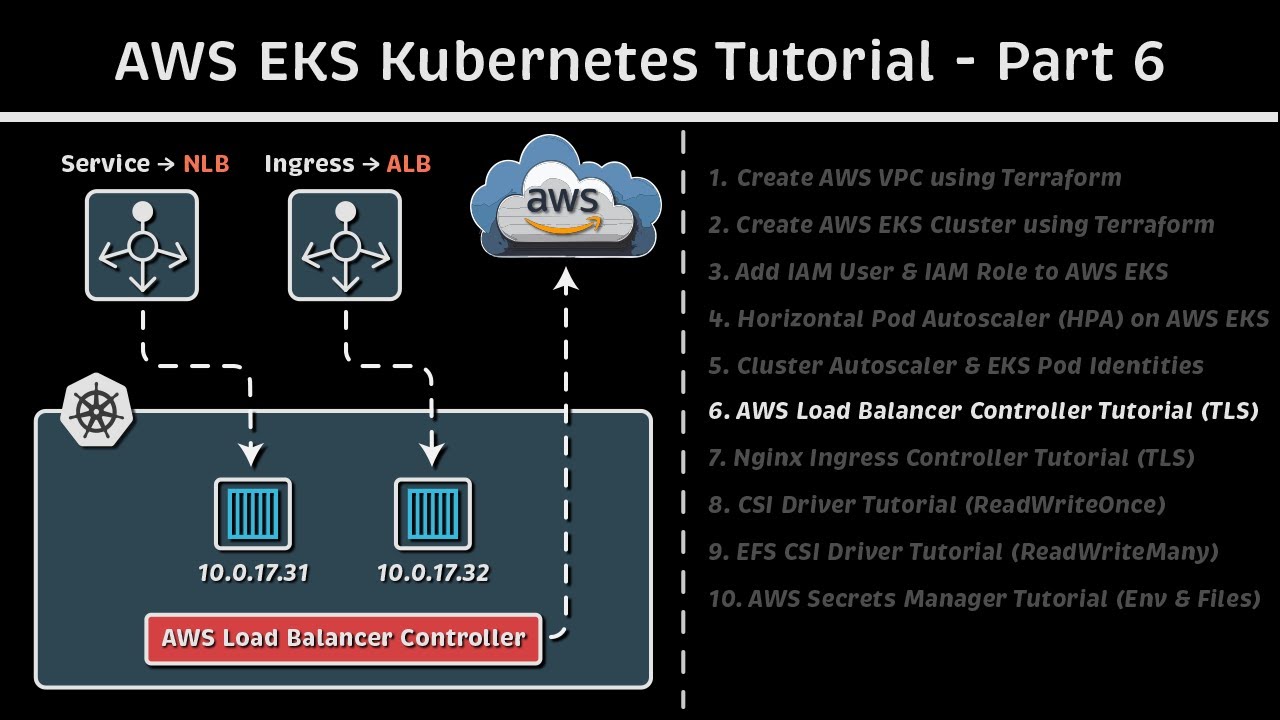
The AWS Load Balancer Controller provides a more efficient way to expose Kubernetes applications than the legacy cloud controller manager, with direct pod IP routing and independent release cycles 1:31-2:05.
Key Takeaways:
• The legacy cloud controller manager creates classic load balancers with node limitations (500 nodes max) and adds unnecessary network hops 0:31-1:30
• AWS Load Balancer Controller can create both Network Load Balancers (layer 4) and Application Load Balancers (layer 7) with direct pod IP targeting 2:30-2:53
• With Application Load Balancers, TLS termination happens outside the cluster using AWS Certificate Manager, improving security 3:04-3:23
• The controller requires proper IAM permissions setup using Terraform before deployment 5:05-6:24
The AWS Load Balancer Controller provides significant advantages over traditional methods by eliminating node limits, reducing network hops, and simplifying TLS management through AWS native services.
Sources:
Generate CPE Credits
Generate a professional CPE document from this video's transcript.
Estimated credit: 0.5 CPE hours
Estimate uses the video runtime (1 hour ≈ 1 CPE, rounded to the nearest 0.5, minimum 0.5, maximum 2.0). The final amount can be lower after review, never higher.
Topic: Cloud Security. Commonly maps to: Security Architecture and Engineering, Communication and Network Security. Exact CISSP domains are assigned during generation.
Free account. One generation at a time, with a daily limit.
CPEBuddy is independent and not affiliated with or endorsed by ISC2, ISACA, or any certification body. Exports are formatted for common CPE submissions; acceptance is at your certification body's discretion.
Transcript Preview
First 800 characters of the transcript
In this lesson, we’ll talk about
how you can expose your application running in Kubernetes to the Internet
or, in some cases, only within a VPC. When you create a typical service of type
LoadBalancer for your application, Kubernetes knows how to create a cloud load balancer,
no matter which cloud provider you use (AWS, Azure, or GCP). This task is performed by
the cloud controller manager that ships with Kubernetes and contains the logic for
creating basic resources in different clouds. When it comes to AWS, for a very long time, it
would by default create a classic load balancer. You can use specific annotations to change the
type, scheme, and other configurations. However, this functionality is still tied
to the Kubernetes source code, which means the development team responsibl…