DEF CON 33 - Reverse Engineering Marine Engines: Make powerboats do your bidding - Alex Lorman
Source: YouTube · DEFCONConference · published Oct 10, 2025 · 24:35
Optimized Summary (Revised Based on Feedback):
The video presents a practical, accessible approach to enabling autonomy in marine vessels—specifically power boats—by avoiding complex reverse engineering of proprietary communication protocols and instead intervening at the user input level. Rather than decoding encrypted or non-standard CAN bus messages, the presenter demonstrates that autonomous control can be achieved by emulating human-like user inputs, such as throttle and steering commands, using simple voltage signals.
Key Insights & Takeaways:
Market Dominance & Legal Barriers:
Major outboard manufacturers—Mercury, Yamaha, Honda, and Suzuki—dominate the market and actively restrict access to their systems due to legal liability concerns, especially around warranty claims and safety. Mercury, in particular, has been known to send formal warnings against such work.Legacy vs. Modern Systems:
While modern engines use advanced digital control systems (e.g., CAN buses, ECUs), many still support legacy cable-driven controls (e.g., push-pull cables for throttle and shift). These systems are more accessible to reverse engineering because they rely on analog voltage signals rather than encrypted or proprietary digital protocols.Hacking via Voltage Emulation:
The core technique involves reading and replicating voltage outputs from Hall effect sensors in throttle controls. For example:- Yamaha’s CDU (2022) uses two Hall effect sensors that output voltages between 0.15V and 1.4V.
- By measuring these ranges and replicating them with simple DACs or digipots, a system can emulate a human operator’s input.
- This method is feasible, reliable, and requires minimal hardware (e.g., $3 components like PWM-to-voltage converters).
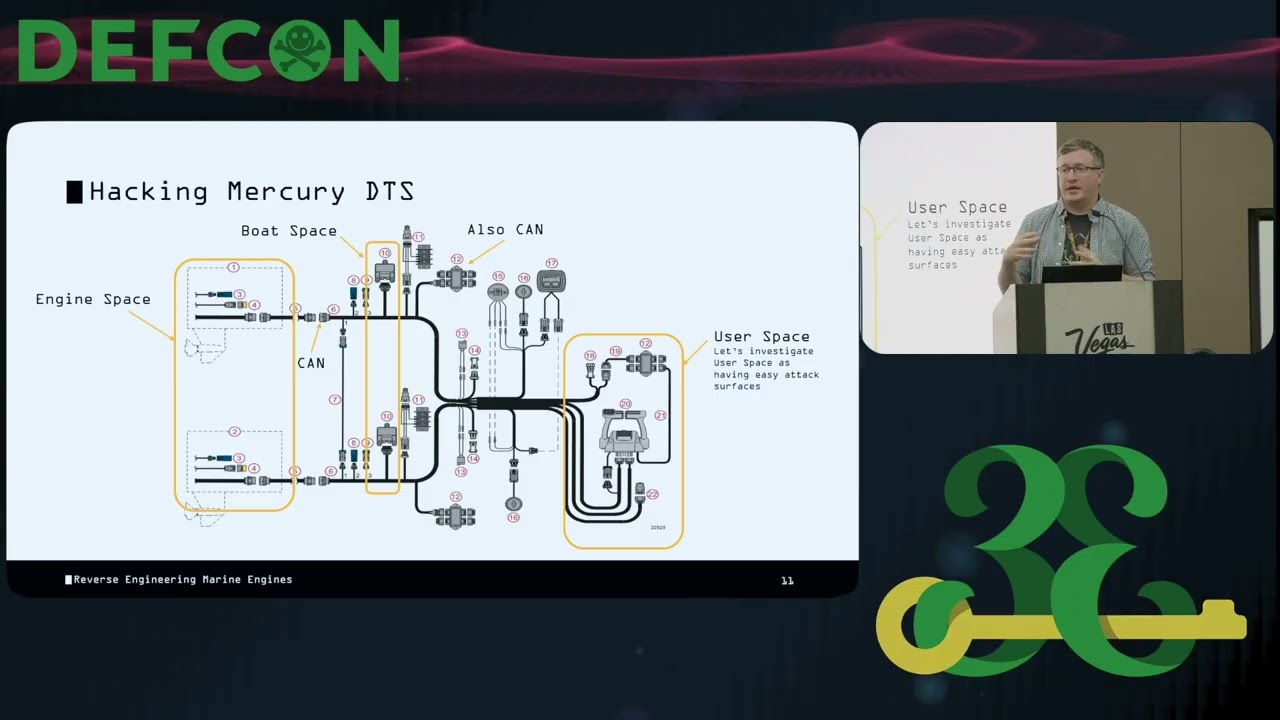
Mercury DTS Architecture (User Space as Intervention Point):
Mercury’s DTS system uses three abstraction layers:- Engine Space
Generate CPE Credits
Generate a professional CPE document from this video's transcript.
Estimated credit: 0.5 CPE hours
Estimate uses the video runtime (1 hour ≈ 1 CPE, rounded to the nearest 0.5, minimum 0.5, maximum 2.0). The final amount can be lower after review, never higher.
Topic: Cybersecurity. Commonly maps to: Security and Risk Management, Security Operations. Exact CISSP domains are assigned during generation.
Free account. One generation at a time, with a daily limit.
CPEBuddy is independent and not affiliated with or endorsed by ISC2, ISACA, or any certification body. Exports are formatted for common CPE submissions; acceptance is at your certification body's discretion.
Transcript Preview
First 800 characters of the transcript
Thank you for coming to reverse engineering marine engines. Uh how to make power boats do your evil bidding. Your bidding may not be evil, but that's really up to you. What we're going to talk about is different types of boats, different type propulsion systems. It's going to start with a broad overview. Uh it may be repetitive for some of you and then we'll move on to like the best architecture and how to make this work properly or how I've made it make it work properly. So a quick overview. So, uh, major outboard OEMs, and that's an outboard motor for those of you, uh, haven't seen them before. That's actually four of them from Mercury. The major OEMs are Mercury, who's owned by Brunswick. We're going to come back to them a bunch. Uh, no specific malice against them, but we're going to c…