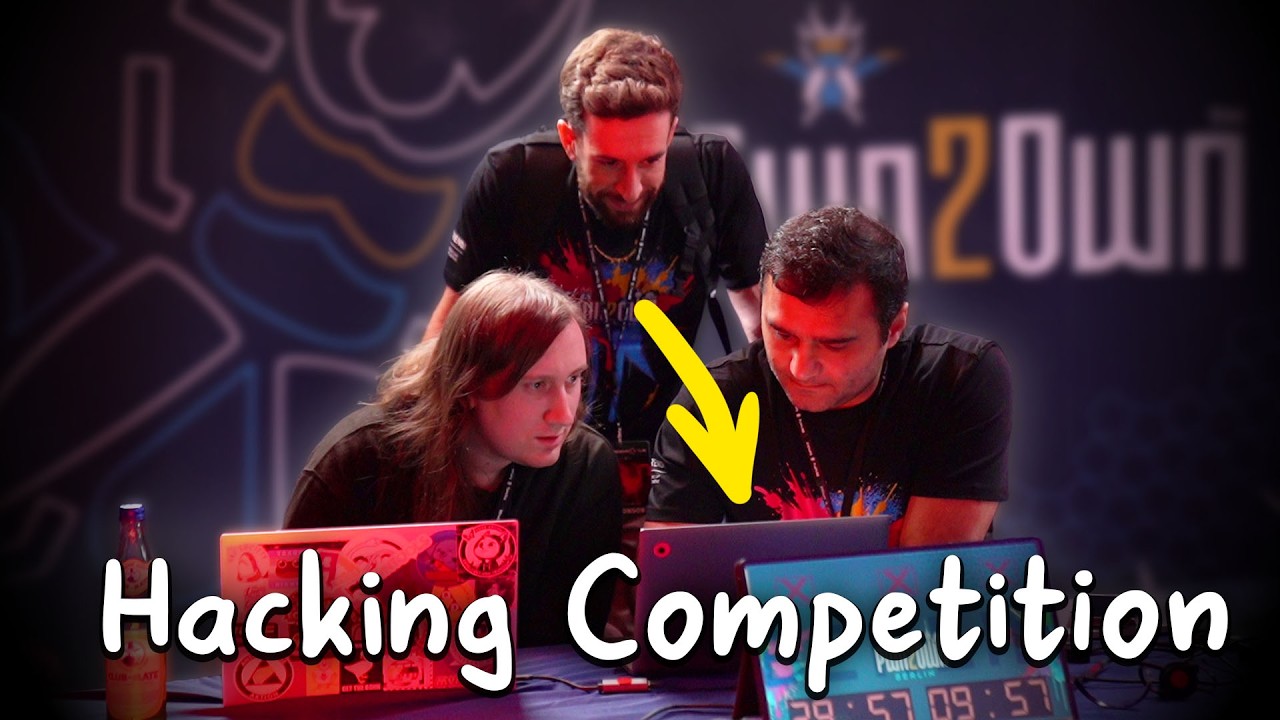
Firefox JIT Bug - Pwn2Own Documentary (Part 3)
Source: YouTube · LiveOverflow · published Mar 1, 2026 · 20:08
BLUF: This video documents a Mozilla fire drill at Pwn2Own Berlin, showcasing how security researcher Manfred Paul discovered a critical JIT optimization bug in Firefox, leading to a successful remote code execution exploit and a rapid, coordinated patching response.
Key Takeaways:
• The Exploit Mechanism: Manfred Paul identified a flaw in Firefox’s JIT compiler where the TryEliminateBoundsCheck function incorrectly merged bounds checks. By exploiting the difference between infinite and modular arithmetic modes, specifically using bitwise OR operations to force 32-bit truncation, he created an out-of-bounds write vulnerability 4:24-4:32.
• Methodology Over Fuzzing: Unlike many researchers who rely on fuzzing, Paul used manual code analysis and a mathematical background to reason about the logic. He proved that the optimizer’s assumption that i + 5 was always less than i + 10 failed when signed integer overflow occurred, allowing him to bypass safety checks 7:09-7:35.
• The Disclosure Process: Upon successful demonstration of code execution on stage, Paul entered a private disclosure room to provide details to Mozilla. The team immediately began bisection to identify the root cause, confirming the bug had existed for roughly six years 0:22-0:44.
• Rapid Patching: Mozilla engineers worked through the incident to create a fix. After verifying the patch did not leave variant vulnerabilities, they prepared a release build that underwent QA to ensure stability before public distribution 0:52-1:22.
• Importance of Fundamentals: The video emphasizes that despite the rise of AI, foundational knowledge in mathematics and system internals is crucial for effective security research and for understanding the limitations of automated tools 18:53-19:46.
Closing Statement: The incident highlights the critical importance of rigorous code analysis in browser security and Mozilla’s capability to respond swiftly to zero-day threats, ensuring user safety remains paramount.
Sources:
- 0:08 Description of the out-of-bounds write exploit leading to remote code execution.
- 0:22 The timeline of the disclosure room entry and initial Mozilla response.
- 4:24 Explanation of the JIT optimization bug and bounds check elimination.
- 7:09 Manfred Paul’s use of mathematical reasoning to identify the flaw.
- 0:52 The process of creating and verifying the initial patch.
- 18:53 Discussion on the necessity of foundational knowledge in the age of AI.
Generate CPE Credits
Generate a professional CPE document from this video's transcript.
Estimated credit: 0.5 CPE hours
Estimate uses the video runtime (1 hour ≈ 1 CPE, rounded to the nearest 0.5, minimum 0.5, maximum 2.0). The final amount can be lower after review, never higher.
Topic: Cybersecurity. Commonly maps to: Security and Risk Management, Security Operations. Exact CISSP domains are assigned during generation.
Free account. One generation at a time, with a daily limit.
CPEBuddy is independent and not affiliated with or endorsed by ISC2, ISACA, or any certification body. Exports are formatted for common CPE submissions; acceptance is at your certification body's discretion.
Transcript Preview
First 800 characters of the transcript
I was able to follow 2 engineers from Mozilla
at the hacking competition, Pwn2Own. On day 1 of the competition,
we saw 1 successful exploit against Firefox: an out-of-bounds write
in the Promise.allSettled function, leading to a remote code execution. And I wanted to highlight
the timeline really quickly because I think in the last
video this was not quite clear. So at 11am,
the demo happened on stage, and then 1 hour later
we were finally able to enter the disclosure room and Mozilla got the exploit details immediately. Engineers started with bisection, which is the process to identify
when the issue was introduced, and that process took a while. And also, one of the engineers, Christian, had to ride with us in the taxi
back to the Mozilla office. So almost 1:30 hours later, it was co…