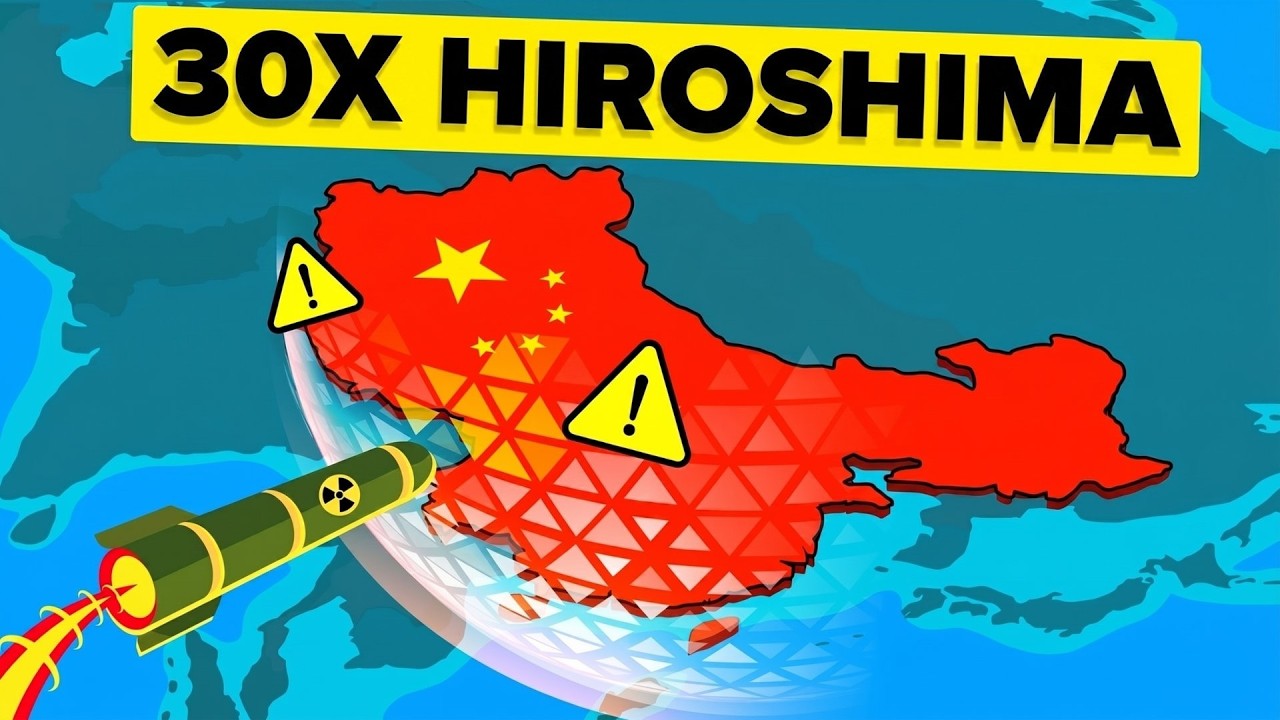
Could CHINA Defend it's Homeland Against a Nuclear Missile Attack
Source: YouTube · The Infographics Show · published Feb 1, 2026 · 21:45
China may survive a limited nuclear strike due to its advanced missile defenses and intact second-strike capabilities, but it cannot withstand a full-scale nuclear assault—highlighting the inherent fragility of nuclear deterrence 1:56-2:00.
Key Takeaways:
• China’s layered missile defense—using early warning satellites, ground-based radars, and interceptors like HQ-9C, HQ-19, and HQ-29—could potentially intercept a limited U.S. strike targeting military infrastructure, though success rates are limited to ~85% under ideal conditions 3:10-9:45.
• A limited strike would destroy key military sites (e.g., Longpo Naval Base, DF-41 silos), kill 25,000–40,000 people, and disrupt command systems, but China retains its second-strike capability and nuclear deterrent 10:00-13:40.
• In a full-scale scenario, hundreds of warheads would target cities, infrastructure, and power grids, killing 110–130 million people within 24 hours and collapsing China’s economy and society 17:00-18:33.
• Even if China retaliates, the resulting nuclear winter and global famine would cause billions of additional deaths, making victory impossible for either side 21:00-21:25.
No nation can reliably defend against nuclear attack—only deterrence prevents war.
Sources:
- 1:56 China’s missile defense network and early warning systems
- 3:10 Overview of Chinese anti-ballistic missile systems (HQ-9C, HQ-19, HQ-29)
- 9:45 Interception success rates and damage from limited strike
- 17:00 Full-scale nuclear attack consequences on cities and infrastructure
- 21:00 Global nuclear winter and long-term humanitarian impacts
Generate CPE Credits
Generate a professional CPE document from this video's transcript.
Estimated credit: 0.5 CPE hours
Estimate uses the video runtime (1 hour ≈ 1 CPE, rounded to the nearest 0.5, minimum 0.5, maximum 2.0). The final amount can be lower after review, never higher.
Topic: Cybersecurity. Commonly maps to: Security and Risk Management, Security Operations. Exact CISSP domains are assigned during generation.
Free account. One generation at a time, with a daily limit.
CPEBuddy is independent and not affiliated with or endorsed by ISC2, ISACA, or any certification body. Exports are formatted for common CPE submissions; acceptance is at your certification body's discretion.
Transcript Preview
First 800 characters of the transcript
Xi Jinping’s worst nightmare has
arrived as he’s rushed into his secure bunker. Nukes are flying
towards Chinese military bases and cities. Could China really defend
its homeland against a nuclear attack? The crisis that was supposed to
stay “contained” over Taiwan is now spiraling out of control. What began
as a naval standoff years earlier quickly evolved into close calls, airspace
violations, and misread signals. Soon, the United States moves forces into
the region to stabilize the situation. Stabilization is not exactly the word Beijing
would use and things get real… very fast. Both sides insist they’re acting defensively,
right up until the point where defensive actions start leading to the sinking of naval
vessels and knocking satellites out of the sky. Facing mounting loss…