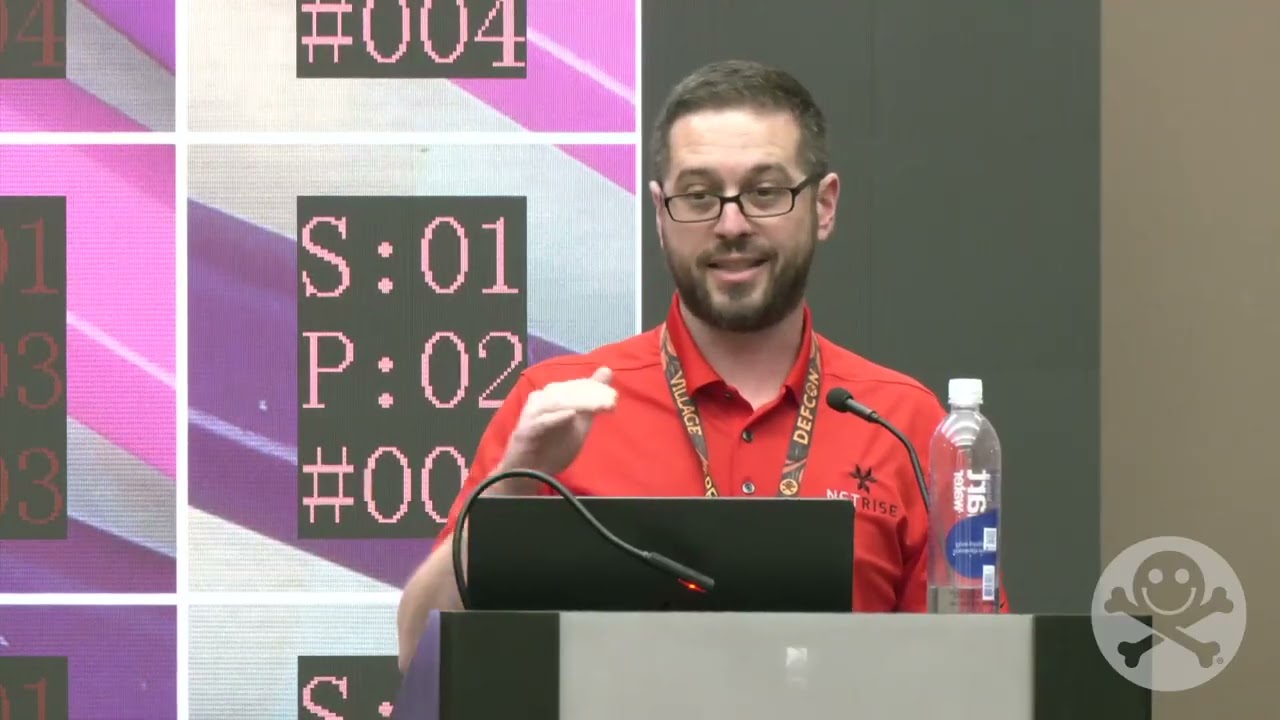
DEF CON 33 - Firmware Decryption: For, and By, the Cryptographically Illiterate - Craig Heffner
Source: YouTube · DEFCONConference · published Oct 10, 2025 · 20:55
The main message is that firmware encryption, while intended to protect devices, often creates vulnerabilities when poorly implemented, allowing reverse engineers to extract keys and decrypt firmware with minimal effort. This is demonstrated through multiple DLink device examples where encryption flaws—such as weak key generation, predictable passphrases, and exposed keys via web interfaces—enable full access to firmware content.
Key Takeaways:
• DLink DAP 1620 uses OpenSSL with a weak passphrase derived from hardware ID and model name, making it vulnerable to decryption via known hashing functions 2:53.
• DLink DAP 2610 employs a flawed rolling XOR of two strings to generate AES keys, which can be easily reverse-engineered in under 15 lines of Python 4:59.
• DLink E15 access point’s firmware is encrypted with OpenSSL, but a command injection in the web interface (via TZ setting) allows extraction of the decryption key, enabling access to all firmware versions 11:45.
• The same base firmware is used across DLink’s product line, making it feasible to extract one key and decrypt all devices using the same method 12:01.
Firmware encryption fails when implemented without secure key derivation or proper bootloader support; instead, it often reveals the encryption mechanism or key directly. This highlights a critical flaw in vendor practices, where encryption undermines security rather than enhancing it.
Sources:
- 2:53 Description of DLink DAP 1620 using weak OpenSSL passphrase derivation.
- 4:59 Explanation of DLink DAP 2610’s rolling XOR key generation method.
- 11:45(https://www.youtube.com/watch?v=TcxVExGxEtk&t=7
Generate CPE Credits
Generate a professional CPE document from this video's transcript.
Estimated credit: 0.5 CPE hours
Estimate uses the video runtime (1 hour ≈ 1 CPE, rounded to the nearest 0.5, minimum 0.5, maximum 2.0). The final amount can be lower after review, never higher.
Topic: Cybersecurity. Commonly maps to: Security and Risk Management, Security Operations. Exact CISSP domains are assigned during generation.
Free account. One generation at a time, with a daily limit.
CPEBuddy is independent and not affiliated with or endorsed by ISC2, ISACA, or any certification body. Exports are formatted for common CPE submissions; acceptance is at your certification body's discretion.
Transcript Preview
First 800 characters of the transcript
Are you ready back there? You good to go? Take that as yes. I don't see anyone else coming in. So, I'm going to start a couple minutes early cuz I got a lot of slides to get through and no projector. So, I'm Craig Hefner. Um, I wrote Benwalk. I work for Netrise doing a bunch of firmware reverse engineering, security analysis. Um, I work at Grey Hat Academy where we teach firmware reverse engineering. So, pulling firmware apart is near and dear to my heart. Um, used to be way back in the day when I was a young lad, most firmware, especially stuff like consumer stuff was never encrypted, right? You could just run it through a tool like Binwok or look at it in a hex editor and kind of figure out what's in it and pull it apart. Um, more and more these days, we're seeing a lot of vendors encryp…