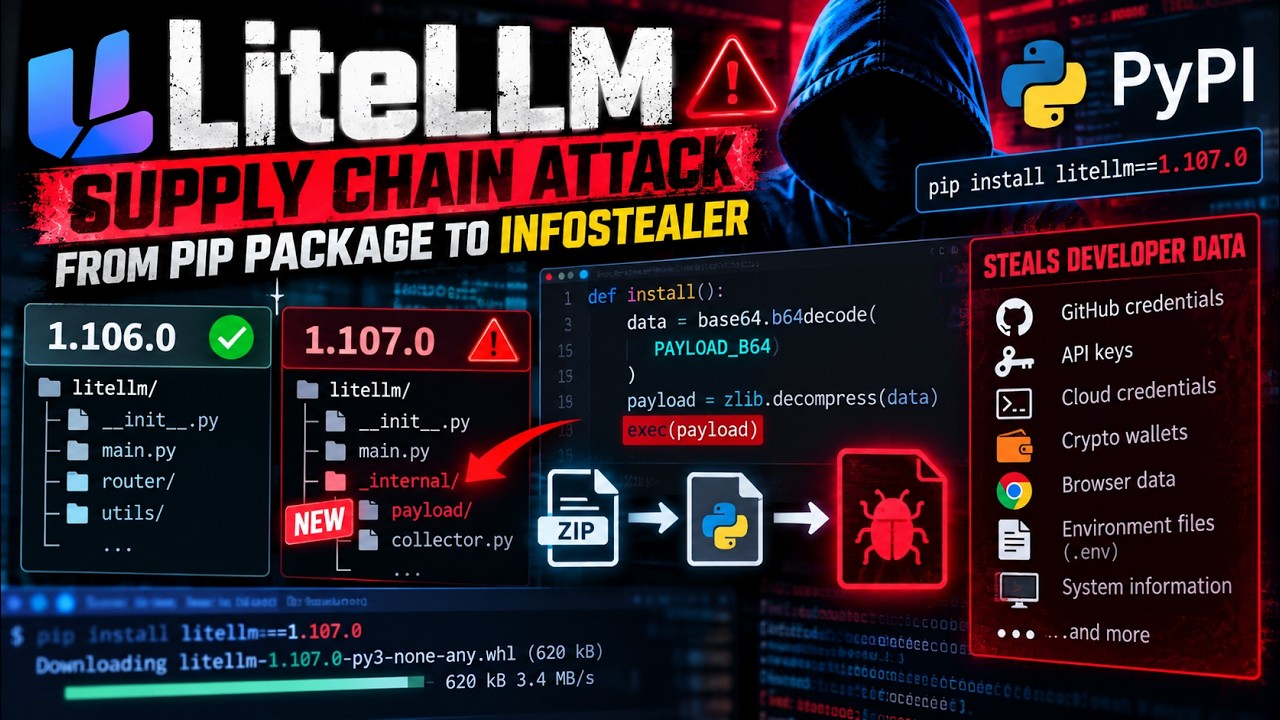
Reverse Engineering the LiteLLM PyPI Supply Chain Attack | From Malicious Package to Infostealer
Source: YouTube · Malware Research Diary · published Oct 22, 2026 · 33:58
[BLUF]
The Python package light-llm version 1.107.0 contains a malicious payload that steals developer credentials, including AWS keys and browser data, while employing AES encryption to evade detection 2:40.
Key Takeaways:
• The malware is hidden in the data folder of the wheel file, which is absent in previous versions, indicating a new supply chain attack vector 2:20.
• The payload targets developers specifically by stealing SSH keys, browser profiles, and AWS credentials, leveraging the typical environment of Python users 18:25.
• Encrypted data is exfiltrated using a hardcoded public key, making reverse engineering the victim's identity difficult for analysts without the private key 23:30.
• The malware executes by importing a malicious module upon installation or runtime, effectively bypassing standard source code reviews 32:50.
[Closing statement]
This incident highlights the critical need for verifying binary wheels against source code to detect hidden malicious components in popular open-source libraries.
Sources:
- 2:40 Explanation of the typical malware payload structure for Python packages.
- 2:20 Identification of the new
datafolder in version 1.107.0 as the attack vector. - 18:25 Analysis of the malware's focus on developer-specific credentials like AWS and SSH keys.
- 23:30 Description of the AES encryption method used to secure exfiltrated data.
- 32:50 Discovery of the malicious module import that triggers the infection.
Generate CPE Credits
Generate a professional CPE document from this video's transcript.
Estimated credit: 0.5 CPE hours
Estimate uses the video runtime (1 hour ≈ 1 CPE, rounded to the nearest 0.5, minimum 0.5, maximum 2.0). The final amount can be lower after review, never higher.
Topic: Malware Analysis. Commonly maps to: Security Operations, Security Architecture and Engineering. Exact CISSP domains are assigned during generation.
Free account. One generation at a time, with a daily limit.
CPEBuddy is independent and not affiliated with or endorsed by ISC2, ISACA, or any certification body. Exports are formatted for common CPE submissions; acceptance is at your certification body's discretion.
Transcript Preview
First 800 characters of the transcript
Hello everyone. Welcome back to another um session in analyzing malware. Um today I I thought um we go over some Python packet is um something very new for me. Um and um so yeah so yesterday I saw there's a implant uh notification um on the one of the Python packet um light llm is containing a malware in there and the the version for this is um 1.107.0 zero. Um, and um, it's a packet that a lot of people download, right? So, it's a high risk uh, threat. Um, here's a blog. So, um, socket.dev did a blog on it. And um I I haven't really read this but basically um the the malware is containing u um the the packet contain a new payload in there and I think it's um so basically in this packet right here right um so what I did is I download so the the packet is um 1.107 107. So I download the um …