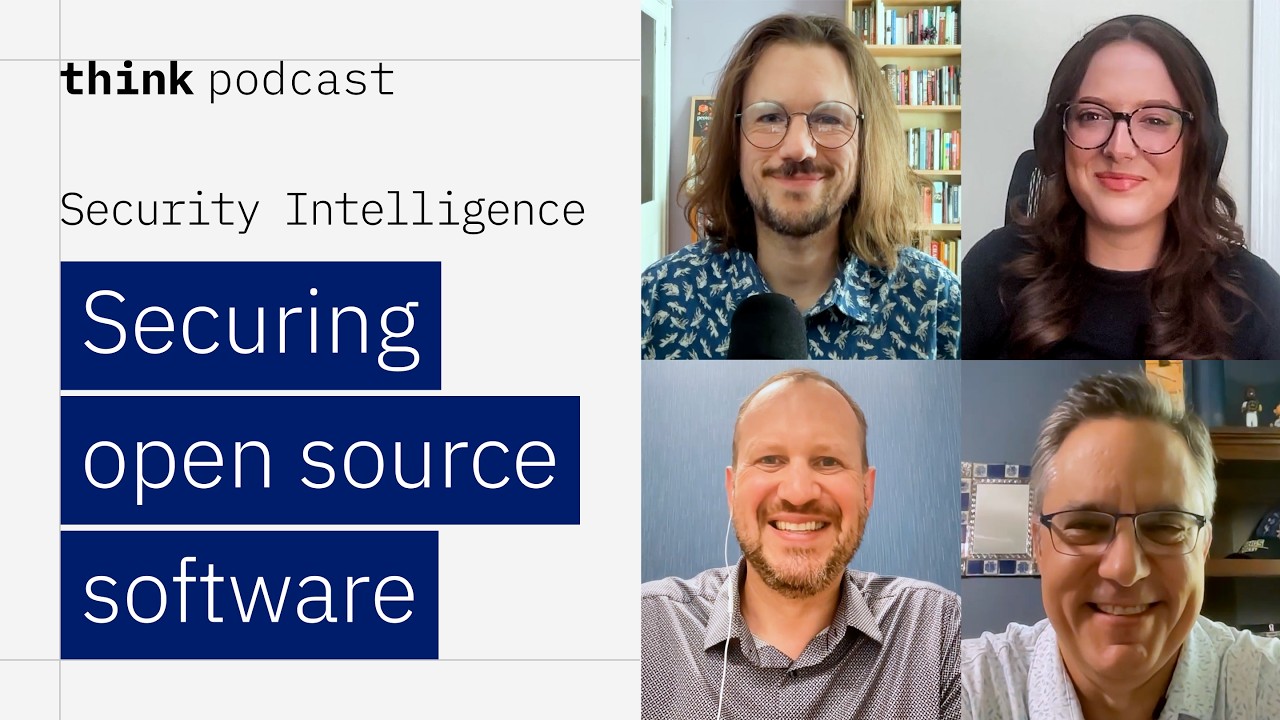
Project Lightwell brings open source security into the AI era
Source: YouTube · IBM Technology · published Jun 3, 2026 · 35:10
BLUF: The podcast covers IBM and Red Hat’s $5B Project Lightwell to secure open-source libraries, a new SIMJacking attack exploiting AI coding agents, and insights from a Layer X report on enterprise AI usage risks 0:49.
Key Takeaways:
• Project Lightwell extends Red Hat’s trusted binary model to 1.5 million language libraries, aiming to secure the software supply chain against AI-driven vulnerability chaining 3:00.
• SIMJacking involves attackers poisoning repositories to trick AI coding agents into overwriting their own configuration files, bypassing human-in-the-loop checks through social engineering 7:30.
• A Layer X report highlights that AI risk is concentrated among "super users," though panelists argue novice users interacting directly with AI tools may be more susceptible to prompt injection errors 13:00.
• Experts emphasize implementing input/output guardrails and maintaining human liability for code reviews, noting that while AI evolves, fundamental security principles regarding data trust and process integrity remain critical 11:30.
Closing Statement: As AI integrates deeper into development workflows, organizations must balance technological adoption with robust guardrails and rigorous human oversight to mitigate evolving security risks.
Sources:
Generate CPE Credits
Generate a professional CPE document from this video's transcript.
Estimated credit: 0.5 CPE hours
Estimate uses the video runtime (1 hour ≈ 1 CPE, rounded to the nearest 0.5, minimum 0.5, maximum 2.0). The final amount can be lower after review, never higher.
Topic: Cybersecurity. Commonly maps to: Security and Risk Management, Security Operations. Exact CISSP domains are assigned during generation.
Free account. One generation at a time, with a daily limit.
CPEBuddy is independent and not affiliated with or endorsed by ISC2, ISACA, or any certification body. Exports are formatted for common CPE submissions; acceptance is at your certification body's discretion.
Transcript Preview
First 800 characters of the transcript
Panelists, what is your biggest concern when it comes to opensource security? >> Maintainer burnout. Trust the model, not the code. >> Some projects have zero or one maintainer working part-time. Others have more resources. So, you just don't know what you're getting. Mixed bag. Hello and welcome to Security Intelligence, IBM's weekly cyber security podcast, where our expert panelists turn the biggest industry news stories into practical takeaways that you can use. I'm your host, Matt Kazinski, and joining me this week, we've got Dave McInness, VP, senior partner, global cyber threat management, IBM Consulting, and two newcomers to the show. We've got Sophie Cunningham, dark web analyst from X-Force Threat Intelligence, and Brent Holded, Global Field CTO from Red Hat. We'll be chatting abo…