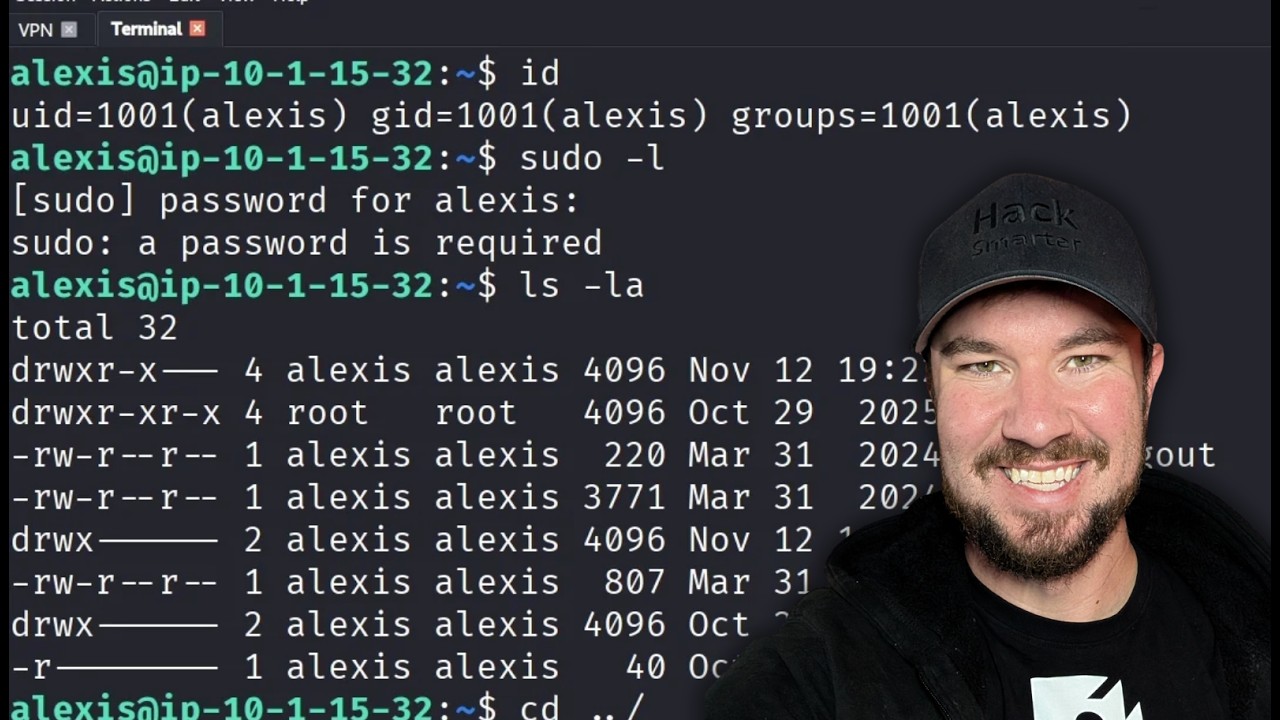
Hacking Linux (GitOops - Part 2)
Source: YouTube · Tyler Ramsbey - Hack Smarter · published Nov 26, 2026 · 24:00
[BLUF]
This video details the post-exploitation phase of the "Git Oops" lab, focusing on fixing a malformed SSH key to gain initial access as the user "Alexis" and identifying Atlantis CI/CD as the primary target for privilege escalation. 2:15-2:30
Key Takeaways:
• The attacker retrieved a Terraform state file from an S3 bucket containing a private SSH key with broken formatting (embedded newlines), which prevented direct usage. 0:30-0:37
• After failing to fix the key with a custom Python script and free AI tools, the attacker used a paid LLM (Gemini) to correctly format the key, allowing successful SSH authentication as the user "Alexis". 7:14-7:37
• Enumeration of the Alexis user revealed no sudo privileges, no bash history, and no immediate persistence vectors, necessitating a deeper search for other services. 11:46-12:30
• The attacker discovered "Atlantis," a Terraform pull request automation tool, installed in the /opt directory, which is the intended path for privilege escalation. 13:30-13:50
• Crucial process analysis (ps auxw) revealed that the Atlantis server is running as the root user, meaning any command execution via Atlantis could lead to root-level access. 21:14-21:40
• Documentation for Atlantis explicitly describes vulnerabilities involving malicious Terraform files in pull requests that can execute arbitrary commands via local_exec or custom build commands. 15:50-16:30
The attacker successfully established initial foothold as Alexis and mapped out the attack vector through Atlantis. The next steps involve authenticating to Atlantis and injecting a malicious Terraform plan to achieve root access.
Sources:
- 0:30-0:37 Discovery of the private SSH key in the S3 bucket state file.
- 2:15-2:30 Discussion on the difficulty of manually fixing SSH key formatting.
- 7:14-7:37 Using a paid LLM to fix the SSH key formatting.
- 13:30-13:50 Identification of the Atlantis CI/CD tool in the /opt directory.
- 21:14-21:40 Observation that Atlantis is running as root.
- 15:50-16:30 Review of Atlantis documentation regarding potential exploitation vectors.
Generate CPE Credits
Generate a professional CPE document from this video's transcript.
Estimated credit: 0.5 CPE hours
Estimate uses the video runtime (1 hour ≈ 1 CPE, rounded to the nearest 0.5, minimum 0.5, maximum 2.0). The final amount can be lower after review, never higher.
Topic: Penetration Testing. Commonly maps to: Security Assessment and Testing, Security Operations. Exact CISSP domains are assigned during generation.
Free account. One generation at a time, with a daily limit.
CPEBuddy is independent and not affiliated with or endorsed by ISC2, ISACA, or any certification body. Exports are formatted for common CPE submissions; acceptance is at your certification body's discretion.
Transcript Preview
First 800 characters of the transcript
What is up everyone? Welcome back to another video. This is going to be part two of working through the Git Oops lab on the HackSmarter platform. And just like I said in part one, this lab is completely free. No payment, no subscription needed. So if you haven't already, make sure you launch the lab, get your black hoodie on, get your Kali VM booted up and get ready to hack all of the things with me. Now we're going to pick up right where we left off at the end of the last video. And remember at the end of the last video, we were digging into an S3 bucket and we found a Terraform state file. We downloaded it to our local Kali machine and as we were digging into it, we found some interesting secrets. So let's pick up right where we left off at the end of the last video. So looking at this b…