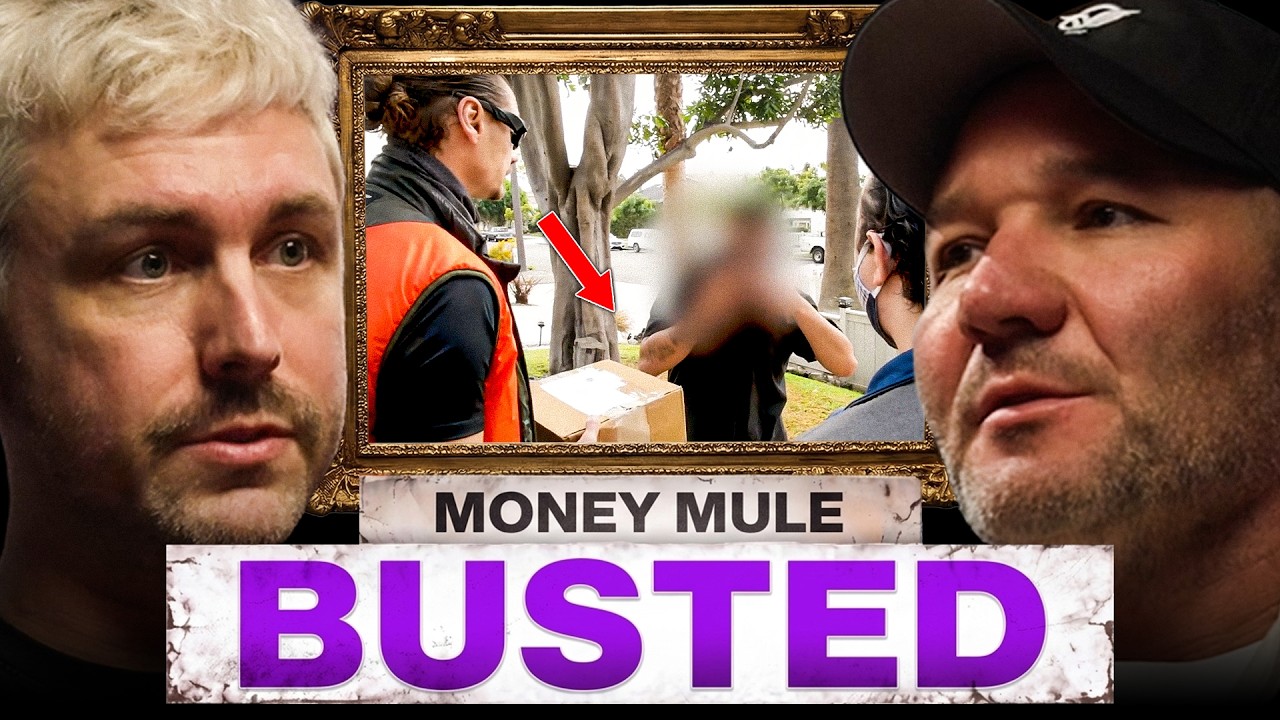
How Empty UPS Packages Helped Expose a $65 Million Scam Network
Source: YouTube · Shawn Ryan Clips · published Oct 12, 2026 · 17:29
This interview explores how a scam-baiting investigator helped take down a $65 million scam network that convinced elderly victims to physically ship cash and gold to money couriers in the US 0:00-0:08.
Key Takeaways:
• Overseas call centers pose as Microsoft, Amazon, or the government, claiming fraudulent charges or hacks, then convince victims to withdraw huge sums of cash, wrap it in foil and boxes, and ship it domestically to money-laundering mules 0:30-1:14
• Scammers coach victims like "grandma" to lie to bank tellers while staying on the phone in her pocket, then use the hawala transfer system, vacant houses, or even in-person gold pickups to collect the money 1:51-3:07
• The scammers are highly skilled: they control and ransom victims' computers, edit bank balances, steal passwords, and isolate trusting elderly victims so they tell no one 4:02-4:35
• The guest recounted saving a recent stroke victim who was driving to a Bitcoin ATM with $40,000 in cash—yet the bank manager kicked him out for questioning why the withdrawal was allowed 4:38-5:24
• The investigation started with scam baiting—posing as victims, planting GPS-tracked packages, and confronting couriers—which generated evidence that grew from one suspect to roughly 24-25 arrests and $65 million (likely representing only ~20% of actual criminal proceeds) over five to six years 8:38-9:16
• The couriers are dangerous and often coerced—some operate out of hotels with guns—so the guest shares evidence directly with law enforcement rather than seeking viral confrontation videos, aiming for mass arrests and victims saved 15:20-17:01
Most scam operations run out of Indian and Pakistani call centers, with crypto scams from Eastern Europe, romance scams from Africa and the UK, and Publishers Clearing House scams targeting seniors from Jamaica 11:28-12:58.
Sources:
- 0:00 Introduction to the $65 million takedown story
- 0:30-1:14 How overseas call center scams trick victims into shipping cash
- 1:51-3:07 Money laundering tactics: hawala, foil-wrapped packages, gold pickups
- 4:02-4:35 Scammers' technical control over victims' computers and accounts
- 4:38-5:24 Stroke victim rescue and bank's complicity
- 8:38-9:16 Scale of the bust: 2,000 victims, ~25 arrests, $65M
- 11:28-12:58 Geographic breakdown of scam types worldwide
- 15:20-17:01 Dangers of courier confrontations and the goal of law enforcement referrals
Generate CPE Credits
Generate a professional CPE document from this video's transcript.
Estimated credit: 0.5 CPE hours
Estimate uses the video runtime (1 hour ≈ 1 CPE, rounded to the nearest 0.5, minimum 0.5, maximum 2.0). The final amount can be lower after review, never higher.
Topic: Cybersecurity. Commonly maps to: Security and Risk Management, Security Operations. Exact CISSP domains are assigned during generation.
Free account. One generation at a time, with a daily limit.
CPEBuddy is independent and not affiliated with or endorsed by ISC2, ISACA, or any certification body. Exports are formatted for common CPE submissions; acceptance is at your certification body's discretion.
Transcript Preview
First 800 characters of the transcript
I want to talk about this this recent thing you did, the $65 million takedown. >> Yeah. >> Can we go into that? >> Sure. Yeah. Yeah. >> Where do we start? >> 2019. Um, I'll kind of like give you what I started to do at first that led to this if that's okay. >> Yeah, that works too. >> So, this this is like from the Susan lady that I was telling you about where I'm like, "Okay, there's just like grandma on the other side." Because what happens is if people aren't aware, um I deal with scammers like in these call centers overseas and they pretend to be like Microsoft for instance or Amazon or some kind of tech company and there's like either a fraudulent charge on your account, something to do with your bank account or you've been hacked and you have to save your money by transferring a bunc…