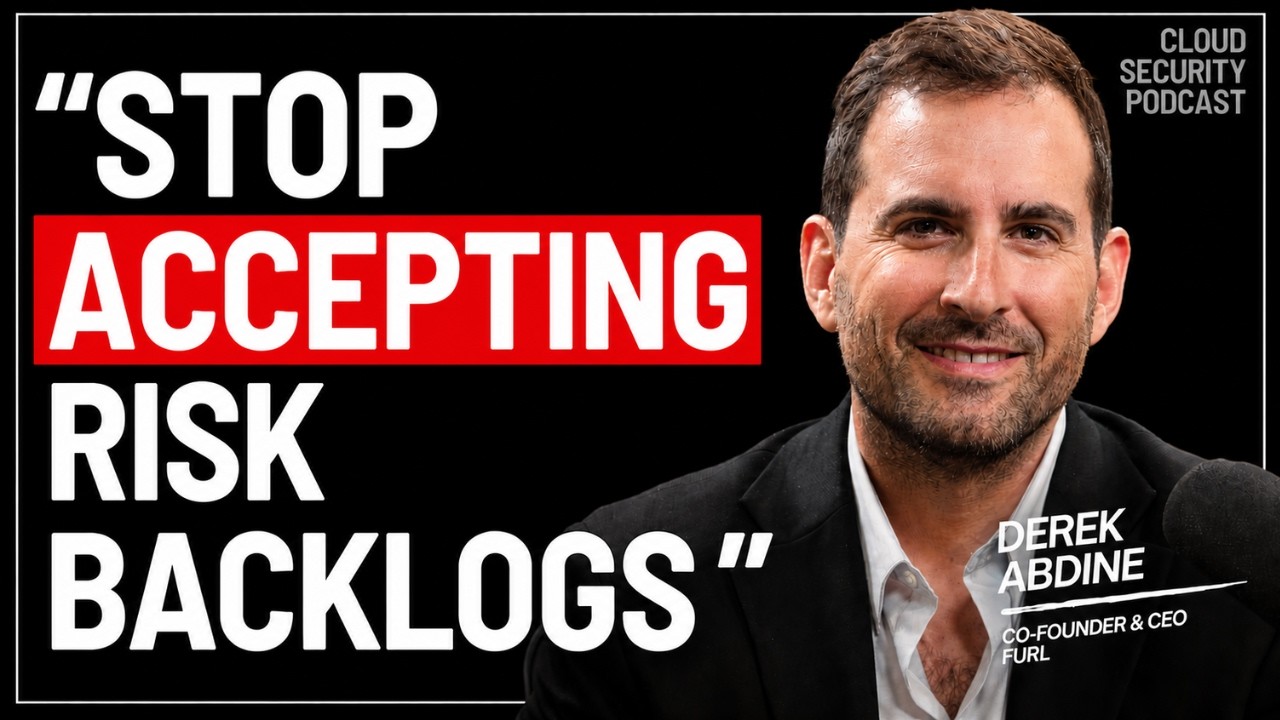
Autonomous AI Remediation: Solving the Vulnerability Backlog | Derek Abdine, Furl
Source: YouTube · Cloud Security Podcast · published Sep 2, 2026 · 34:32
This episode argues the scan-report-ticket model of vulnerability management is broken, and AI-driven, context-aware remediation can finally reduce backlogs at scale 1:02.
Key Takeaways:
• Remediation resists automation—every endpoint differs, so AI must reason about context, apply fixes, and verify they stick 3:13
• Legacy processes take 30–90 days or end as exceptions, leaving stagnant backlogs and no risk burn-down 5:47
• Separate CVEs from configuration weaknesses, using secure baselines to define desired state 8:50
• Models like Mythos find source-code flaws but can't patch compiled artifacts—that gap remains unsolved 13:49
• The npm/Axios incident (stolen token injecting a remote access toolkit into a library downloaded 100M times monthly) demands autonomous forensic response over war rooms and 50 tools 15:05
• In OT and healthcare, patching is often impossible—containment and isolation are the right strategies 21:27
• Skepticism toward vendors whose solution is just "AI"; good products interleave models into real workflows 27:11
• With zero-day windows compressing from ~270 days to hours, security and IT must blend into one function 29:38
AI hasn't earned full trust—guardrails and humans in the loop stay essential—but good context lets it accelerate the grindy work while people keep accountability 25:09.
Sources:
Generate CPE Credits
Generate a professional CPE document from this video's transcript.
Estimated credit: 0.5 CPE hours
Estimate uses the video runtime (1 hour ≈ 1 CPE, rounded to the nearest 0.5, minimum 0.5, maximum 2.0). The final amount can be lower after review, never higher.
Topic: Cybersecurity. Commonly maps to: Security and Risk Management, Security Operations. Exact CISSP domains are assigned during generation.
Free account. One generation at a time, with a daily limit.
CPEBuddy is independent and not affiliated with or endorsed by ISC2, ISACA, or any certification body. Exports are formatted for common CPE submissions; acceptance is at your certification body's discretion.
Transcript Preview
First 800 characters of the transcript
The way the stack was designed for the last 30 years won't work the same way for the next 30. It can't because the problem has fundamentally changed so the solution has to fundamentally change. It's downloaded 100 million times a month or and the developer had their publishing token to the NPM repository stolen. They took the library and they inject a remote access toolkit in it. Long long story short, you get compromised if you pull this library and you feel shame every time you see the reports coming out that you're not making enough progress. Scan the network in a power plant, guess what happens? You knock over all the PLCs and valves in the compression of time. But I think it was like 270 days in 2018 and now it's like hours or minutes. Model that is really good at looking at source co…