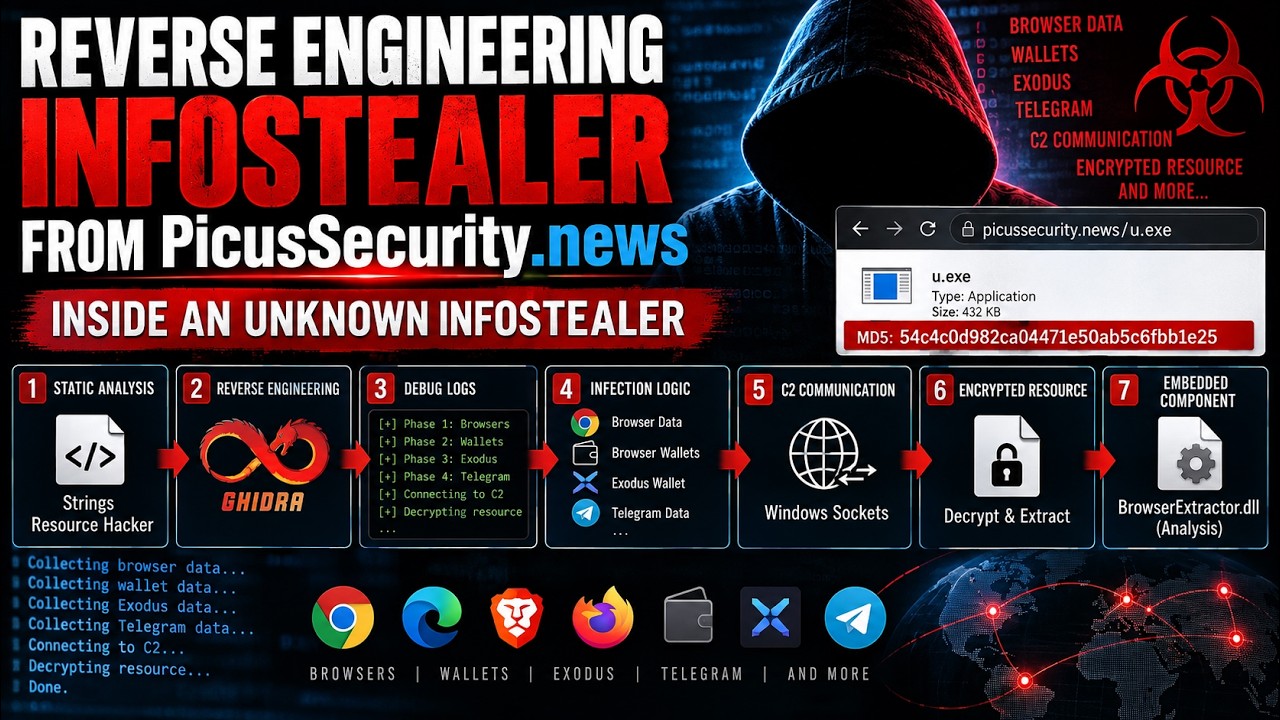
Reverse Engineering an Infostealer from PicusSecurity.news | Inside an Unknown Infostealer
Source: YouTube · Malware Research Diary · published Sep 15, 2026 · 47:47
[BLUF with citation]
This video details the reverse engineering of an info-stealer malware, analyzing its persistence mechanisms, data exfiltration methods, and communication with command-and-control (C2) servers 2:53.
Key Takeaways:
• The malware is an encrypted Windows executable that embeds a browser extractor DLL within its resources, which is decrypted and executed at runtime 3:28.
• It targets multiple browsers including Chrome, Edge, Brave, and Opera to steal credentials and session cookies 21:12.
• The infection process involves establishing persistence via registry keys and creating a mutex to prevent multiple instances 25:44.
• Data is exfiltrated using raw Windows Sockets (WS2_32) to communicate with a hardcoded C2 IP address 28:54.
• The malware employs encryption for its internal data and verifies the integrity of messages sent to the C2 server 34:13.
• The analyst identifies specific API calls for file persistence, such as writing to the registry, which helps in tracing the malware's behavior 25:44.
[Closing statement]
The analysis demonstrates how modern info-stealers use embedded payloads and standard Windows APIs to maintain persistence and securely transmit stolen data to attackers.
Sources:
- 2:53 Introduction to the malware file and initial analysis steps
- 3:28 Examination of encrypted resources using Resource Hacker
- 21:12 Identification of targeted browsers for credential theft
- 25:44 Analysis of persistence mechanisms and registry modifications
- 28:54 Reverse engineering of socket communication for C2 connectivity
- 34:13 Discussion on data encryption and integrity verification during exfiltration
Generate CPE Credits
Generate a professional CPE document from this video's transcript.
Estimated credit: 1 CPE hours
Estimate uses the video runtime (1 hour ≈ 1 CPE, rounded to the nearest 0.5, minimum 0.5, maximum 2.0). The final amount can be lower after review, never higher.
Topic: Malware Analysis. Commonly maps to: Security Operations, Security Architecture and Engineering. Exact CISSP domains are assigned during generation.
Free account. One generation at a time, with a daily limit.
CPEBuddy is independent and not affiliated with or endorsed by ISC2, ISACA, or any certification body. Exports are formatted for common CPE submissions; acceptance is at your certification body's discretion.
Transcript Preview
First 800 characters of the transcript
Hello everyone. Welcome back to another session in analyzing malware. It's been a while. Um I've been off for about two weeks now since I get sick. Um so just want to do a quick an analysis. Um so recently I am investigating info stealer malware and this is one of the screenshot I obtained it. Um and as you seen here the user seem to be testing um shown in this um urls bar here the command for um parasel right so command here. So, um the the website is Perus Security News and what I thought would be interesting is that um here in the in the logs in the data um the URLs is the payload is is here right the picker security.news.abc.ext text. Um, it seem to be offline um, right now. Um, but the URLs for one of the payload is in here. So, let's take a look and see what it is. Um, there are vari…