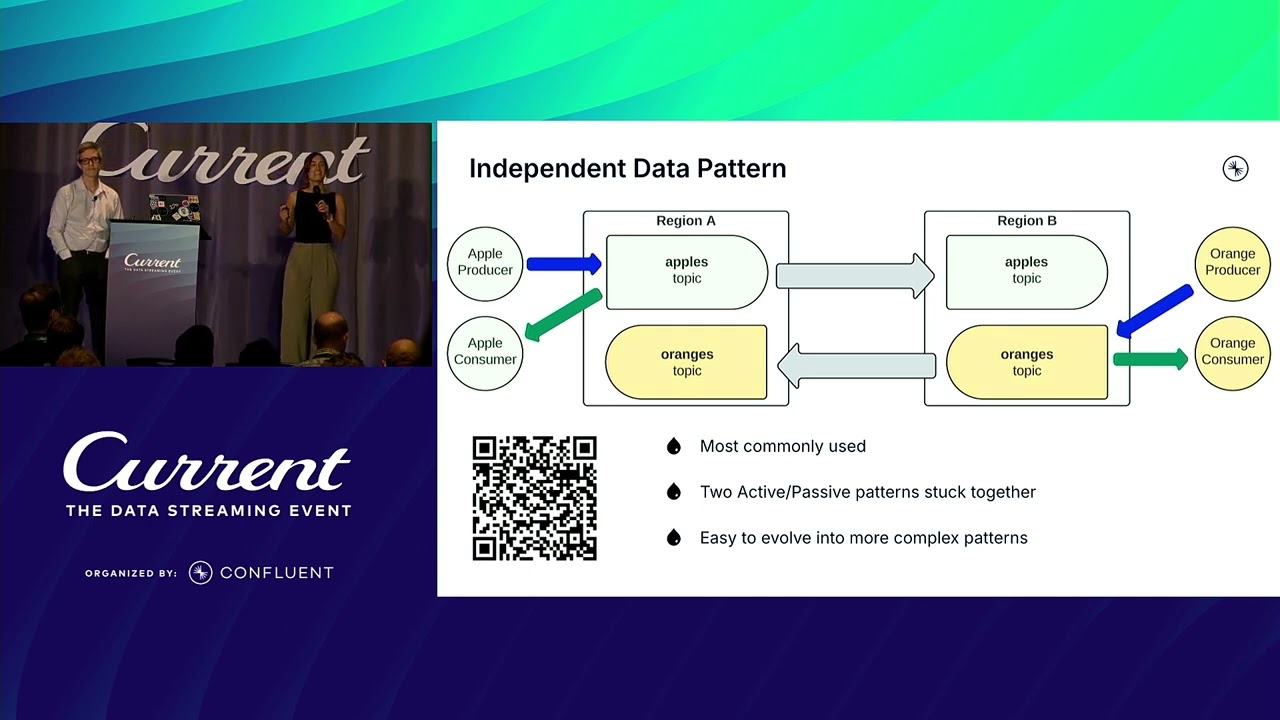
Getting Gory with Active-Active Multi-Region Disaster Recovery (Confluent) | Current 24
Source: YouTube · Confluent Developer · published Oct 28, 2024 · 29:03
Active-active multi-region disaster recovery is often unnecessary and overly complex; simpler, asynchronous replication strategies like inter-cluster replication (e.g., Confluent Replicator, Cluster Linking) are more practical, cost-effective, and suitable for most use cases, especially when data locality and latency matter. These approaches offer greater distance support, flexible topologies, and lower operational overhead compared to stretch clusters.
Key Takeaways:
• Active-active setups are not required; many use cases achieve disaster recovery with asynchronous replication and active-passive patterns 3:00.
• RPO (data loss tolerance) and RTO (recovery time) are critical—zero RPO demands synchronous replication, while near-zero RTO requires automation 1:00.
• Inter-cluster replication enables multi-region DR with broader distance support and flexible topologies beyond stretch clusters 9:00.
• Message ordering must be managed at the producer level using message keys, especially in cumulative data patterns where consumers read from split topics 14:14.
• Failover requires application restarts to update cluster configurations, significantly impacting RTO and necessitating automation 21:00.
• Asynchronous replication risks data loss, but this can be mitigated by capturing a data window before failure and ensuring consumers handle out-of-order or duplicate messages 25:00.
Failover and failback are automated, with Cluster Linking offering built-in pause/resume and simplified orchestration.
Sources:
- 2:00 RPO/RTO definitions and business context
- [9:00](https://www
Generate CPE Credits
Generate a professional CPE document from this video's transcript.
Estimated credit: 0.5 CPE hours
Estimate uses the video runtime (1 hour ≈ 1 CPE, rounded to the nearest 0.5, minimum 0.5, maximum 2.0). The final amount can be lower after review, never higher.
Topic: Cloud Security. Commonly maps to: Security Architecture and Engineering, Communication and Network Security. Exact CISSP domains are assigned during generation.
Free account. One generation at a time, with a daily limit.
CPEBuddy is independent and not affiliated with or endorsed by ISC2, ISACA, or any certification body. Exports are formatted for common CPE submissions; acceptance is at your certification body's discretion.
Transcript Preview
First 800 characters of the transcript
we're going to be talking about uh different approaches to achieving uh active active operation and Disaster Recovery across multiple regions now you probably think it's called getting gory because you know we're going to get into gory details but in fact we're going to completely gloss over all the details okay because that's hard instead we just wanted to use a horror theme because we're really into Halloween okay in fact we might get into a few details but we need to leave time for questions at the end so um first off I just want to quickly Baseline on a few terms Concepts um and assumptions so to start off while there are kind of different flavors of active active that Julie is going to be touching on two of them when we say active active we're simply mean that there's active data bein…