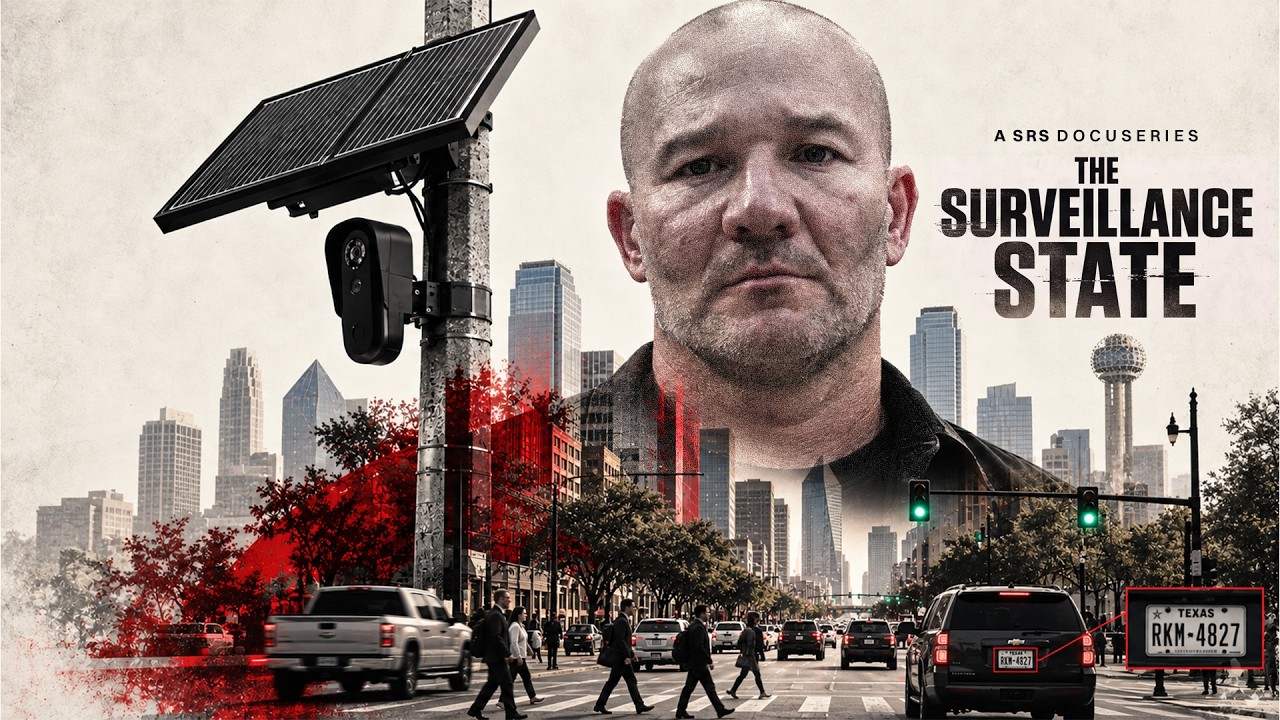
Shawn Ryan Investigates Flock Safety
Source: YouTube · Shawn Ryan Show · published Oct 21, 2026 · 25:34
[BLUF]
The rapid expansion of private surveillance networks in the US, led by companies like Flock Safety and Axon, has created a pervasive data infrastructure that tracks citizens' movements and behaviors, raising significant privacy and civil liberty concerns despite some public safety benefits 0:36.
Key Takeaways:
• Proliferation of Surveillance Infrastructure: Flock Safety has deployed over 120,000 cameras across 6,000 communities, creating the largest private surveillance network in the country by leveraging machine learning to profile vehicles beyond just license plates 5:51.
• Unauthorized Data Sharing and Privacy Violations: Investigations revealed that federal agencies, including ICE, accessed local Flock data without proper consent or knowledge of local police departments, leading to public backlash and cities like Evanston ordering cameras removed 10:54.
• The "Surveillance Rebranding" Trend: As cities cancel contracts with Flock due to privacy concerns, they often switch to competitors like Axon, which also holds federal contracts with immigration agencies, meaning the surveillance footprint remains intact despite vendor changes 19:00.
• Expansion into Drones and Commercial Sectors: Flock is aggressively expanding into autonomous drone surveillance, marketing "guards in the sky" to retail chains, hospitals, and warehouses, thereby extending aerial monitoring beyond traditional policing contexts 17:17.
• Impact on Consumer Privacy and Pricing: Data brokers analyze location histories to infer sensitive personal details (such as health or political leanings) and engage in "surveillance pricing," where algorithms adjust costs for individuals based on their specific data profiles 21:17.
• Public Pushback and Awareness: Citizens are increasingly utilizing tools like the "Dlock" map to track camera locations and avoid surveillance, while activists physically disable cameras and pressure cities to suspend contracts, highlighting a growing tension between safety and privacy 16:11.
[Closing statement]
The surveillance ecosystem is evolving from static camera networks to dynamic, cross-agency data sharing and aerial monitoring, driven by both law enforcement needs and commercial interests. Citizens are advised to stay informed about local contracts and use available tools to understand and mitigate their digital footprint.
Sources:
- 5:51 Discussion of Flock Safety's scale and vehicle profiling capabilities.
- 10:54 Details on unauthorized federal access to local data and city responses.
- 19:00 Analysis of cities switching vendors without reducing surveillance.
- 17:17 Information on Flock's expansion into drone technology.
- 21:17 Explanation of data brokers and surveillance pricing practices.
- 16:11 Overview of public tools and activism against surveillance.
Generate CPE Credits
Generate a professional CPE document from this video's transcript.
Estimated credit: 0.5 CPE hours
Estimate uses the video runtime (1 hour ≈ 1 CPE, rounded to the nearest 0.5, minimum 0.5, maximum 2.0). The final amount can be lower after review, never higher.
Topic: Cybersecurity. Commonly maps to: Security and Risk Management, Security Operations. Exact CISSP domains are assigned during generation.
Free account. One generation at a time, with a daily limit.
CPEBuddy is independent and not affiliated with or endorsed by ISC2, ISACA, or any certification body. Exports are formatted for common CPE submissions; acceptance is at your certification body's discretion.
Transcript Preview
First 800 characters of the transcript
Whether you know it or not, right now there is a surveillance network being built around you. You probably didn't vote for it. You probably didn't sign up for it. And there's a good chance nobody ever told you it was there. Cameras are reading license plates across the country. Drones can launch over municipalities. Data brokers are building profiles on ordinary Americans using information most people never realized they were giving away piece by piece. These systems are being connected. And when you put them together, they can paint a remarkably detailed picture of your life. Where you go, what you see, what you buy, and even what you believe. But this technology isn't inherently good or evil. The same camera network that raises questions about your privacy can help locate a stolen vehicl…