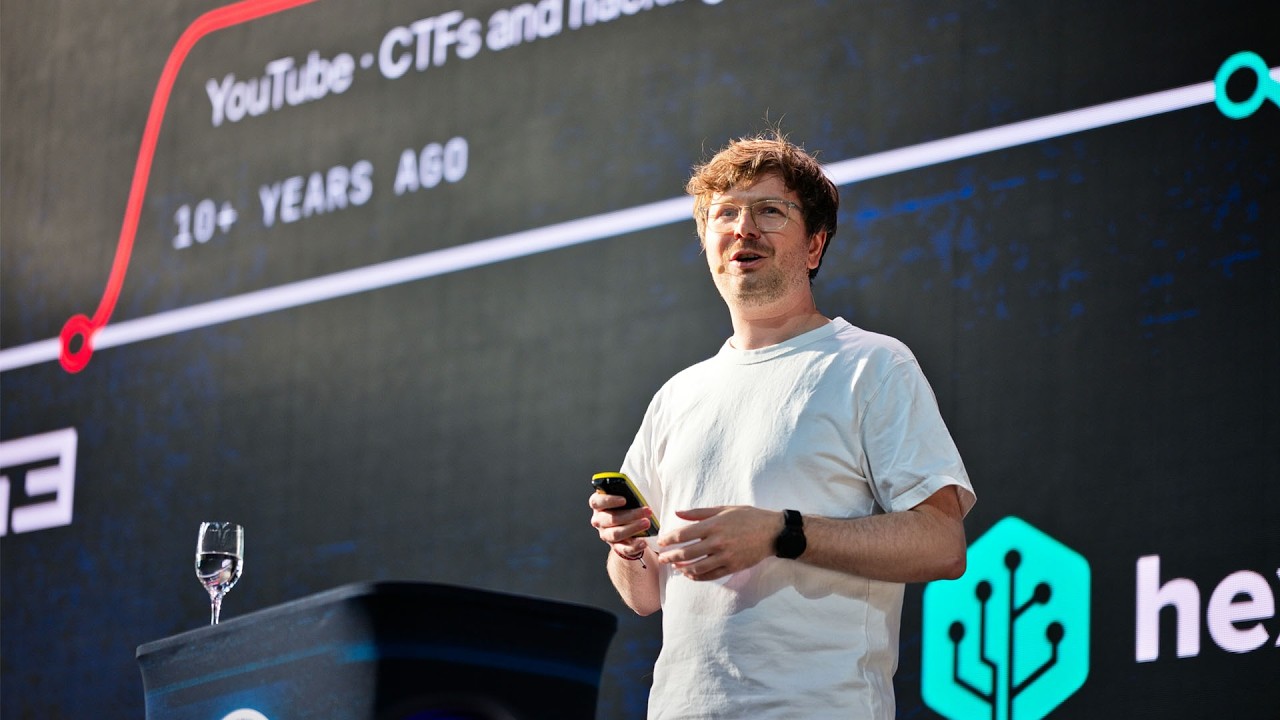
Self-efficacy in the age of AI
Source: YouTube · LiveOverflow · published Oct 19, 2026 · 28:26
BLUF: Fabian "LiveOverflow" Faessler delivers an inspirational address to the European Cyber Security Challenge, arguing that while AI provides "reach" by extending the capabilities of skilled experts, it cannot replace the deep foundational knowledge and "self-efficacy" required to solve complex, novel problems. He urges attendees to view learning as a cumulative process of "mining blocks," emphasizing that the journey of understanding is more valuable than the immediate result, and that true champions are defined by their resilience in the face of frustration.
Key Takeaways:
• The speaker shares a tennis analogy from Roger Federer, noting that even world-class players only win 54% of individual points but 80% of matches, illustrating that consistent small advantages compound into victory 3:35.
• He introduces the concept of "self-efficacy," defined as the belief in one's capacity to execute actions necessary to reach goals, even when facing difficult challenges without knowing the solution 6:43.
• Learning is compared to a Minecraft world where every block broken represents effort and knowledge gained; starting anywhere is fine because the world is deep and interconnected 10:25.
• AI acts as a "radar" or "reach hack" that allows skilled individuals to find vulnerabilities they might not have discovered alone, but it relies entirely on the user's existing deep understanding of the system 14:18.
• The speaker recounts his own failed attempts to find zero-days using AI, contrasting them with successful exploits by skilled engineers who used AI to amplify their intimate knowledge of Firefox and Next.js architectures 19:29.
• Relying solely on AI without building foundational skills is a path to mediocrity; as AI capabilities grow, job requirements will rise, and those who continue to "dig holes" and learn deeply will succeed 25:54.
The speaker concludes by encouraging the audience to stay curious, never stop learning, and always go deeper into the layers of technology. He reminds them that even if specific skills become obsolete, the resilience and problem-solving mindset they have built will allow them to succeed in any future scenario.
Sources:
- 3:35 Discussion of Roger Federer's tennis statistics (54% points won vs 80% matches won).
- 6:43 Definition of "self-efficacy" and its importance in overcoming frustration.
- 10:25 The Minecraft analogy for learning and skill acquisition.
- 14:18 Explanation of AI as a tool that provides "reach" rather than replacing skill.
- 19:29 Example of Firefox engineers using AI to find vulnerabilities, highlighting the need for prior expertise.
- 25:54 Warning against relying on AI without foundational knowledge and the future of job requirements.
Generate CPE Credits
Generate a professional CPE document from this video's transcript.
Estimated credit: 0.5 CPE hours
Estimate uses the video runtime (1 hour ≈ 1 CPE, rounded to the nearest 0.5, minimum 0.5, maximum 2.0). The final amount can be lower after review, never higher.
Topic: Cybersecurity. Commonly maps to: Security and Risk Management, Security Operations. Exact CISSP domains are assigned during generation.
Free account. One generation at a time, with a daily limit.
CPEBuddy is independent and not affiliated with or endorsed by ISC2, ISACA, or any certification body. Exports are formatted for common CPE submissions; acceptance is at your certification body's discretion.
Transcript Preview
First 800 characters of the transcript
For our next speaker. We have another real hacker on stage, and
I think you all or most of you know him. And also, I think most of
us are influenced by him. Please welcome on stage. Fabian
Faessler. LiveOverflow. Hello everybody. My name is Fabian and I guess some
of you know me as LiveOverflow. But just for those few people that don't know me, I've been working as a penetration
tester for over 13 years now. And around ten years ago, I created
a YouTube channel called LiveOverflow where I cover Capture the Flag competitions
and cover all kinds of other hacking topics. In around three years ago, I founded together
with Tomas Stacksmashing, an online training platform, Hextree, and we sponsored, as you
heard, the hardware challenge this year. Seeing you all here reminds me of
mysel…