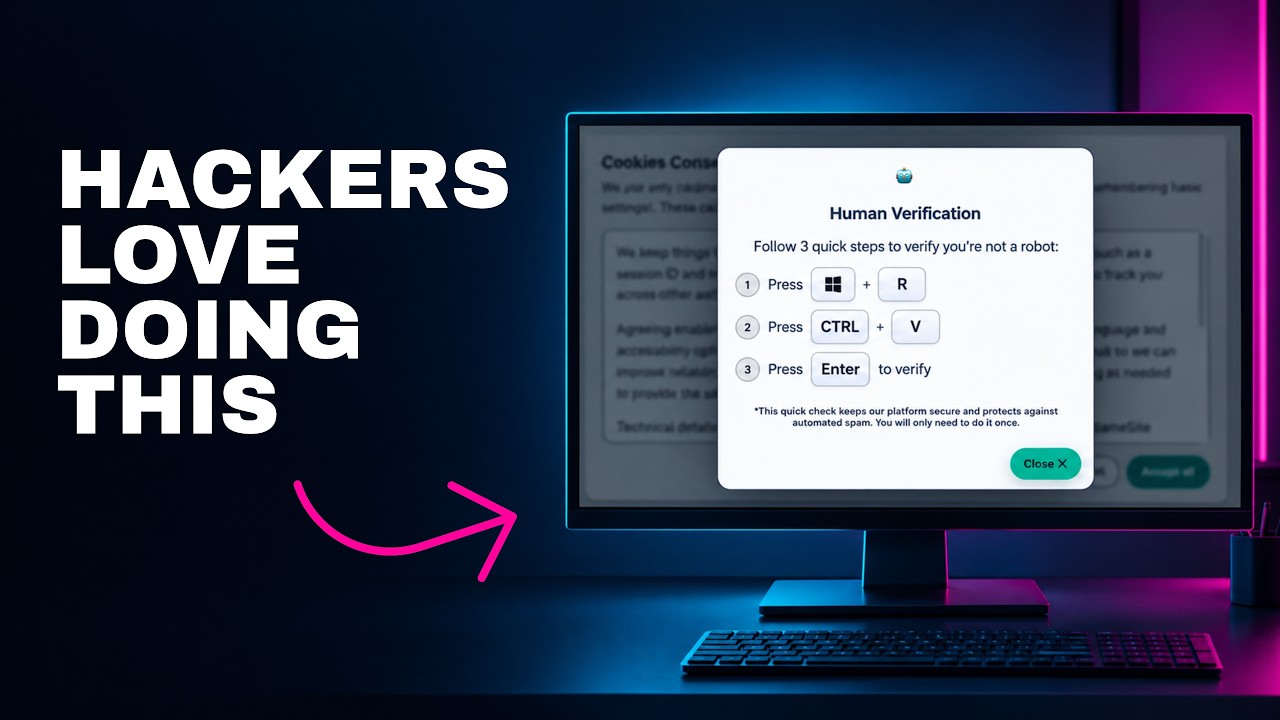
How Hackers Get Users to Do Their Job for Them (Hacking Demo)
Source: YouTube · Huntress · published Oct 15, 2026 · 17:18
BLUF: Huntress demonstrates how attackers bypass modern security controls like Multi-Factor Authentication (MFA) by manipulating users into performing normal actions, such as clicking links or approving logins, to achieve full account compromise without using malware or exploits.
Key Takeaways:
• Token Theft via "ClickFix" and AI-Generated Phishing: CEO Kyle Hanselman used an AI-generated email with a fake "I'm not a robot" captcha to trick a user into pasting malicious clipboard commands. This allowed him to steal session cookies and perform token impersonation, gaining access to the victim's Outlook inbox without needing their password or MFA device 2:15.
• Privilege Escalation via Misconfigured App Registrations: Attacker Scott Riley exploited a standard user’s owned enterprise application with excessive permissions. By creating a long-lived secret key and using AI to automate Graph API calls, he elevated a standard user to Global Admin status in under 6 minutes, bypassing several potential security controls 11:40.
• Automated Compromise via Device Code Phishing: Huntress tracked the "Evil Tokens" campaign, where attackers used a phishing-as-a-service platform to send a campaign code. Users copying and pasting this code inadvertently authenticated the attacker, granting immediate access to emails and OneDrive files without stealing passwords or defeating MFA 15:06.
Closing Statement: These demonstrations highlight that the primary vulnerability in modern cloud security is often the user interface itself, specifically how login prompts and authentication requests can be manipulated. Defending against these threats requires visibility into session anomalies and strict control over application permissions, rather than relying solely on perimeter defenses.
Sources:
- 2:15 Demonstration of AI-generated phishing emails and the "ClickFix" clipboard technique to steal session tokens.
- 5:11 Explanation of how stolen session cookies allow attackers to impersonate users without MFA.
- 11:40 Example of escalating privileges by abusing permissions in an enterprise application registration.
- 14:47 Overview of the "Evil Tokens" phishing-as-a-service campaign affecting hundreds of organizations.
- 15:06 Live demo of device code phishing allowing immediate access to OneDrive and emails.
- 16:42 Summary of common attack vectors: fake captchas, phishing login pages, and device code prompts.
Generate CPE Credits
Generate a professional CPE document from this video's transcript.
Estimated credit: 0.5 CPE hours
Estimate uses the video runtime (1 hour ≈ 1 CPE, rounded to the nearest 0.5, minimum 0.5, maximum 2.0). The final amount can be lower after review, never higher.
Topic: Cybersecurity. Commonly maps to: Security and Risk Management, Security Operations. Exact CISSP domains are assigned during generation.
Free account. One generation at a time, with a daily limit.
CPEBuddy is independent and not affiliated with or endorsed by ISC2, ISACA, or any certification body. Exports are formatted for common CPE submissions; acceptance is at your certification body's discretion.
Transcript Preview
First 800 characters of the transcript
Three attacks with no exploits, no malware, and no zero days. Every one of them worked because real employees did something completely normal. Clicked a link, typed a password, approved to login, had no idea they had just handed over the attacker everything they needed. That's the pattern behind every attack in this video. So, to show you exactly what it looks like in practice, we pulled together three real demonstrations from three teams here at Huntress. Each one showing a different way attackers get the user to do their job for them and never trip an alarm. First up, our own CEO Kyle Hanselan. Before Huntress, he broke into things at the NSA. Old habits die hard. Kyle starts with something anyone can buy. A stolen login off the dark web for about the price of a large pizza. He logs in. …