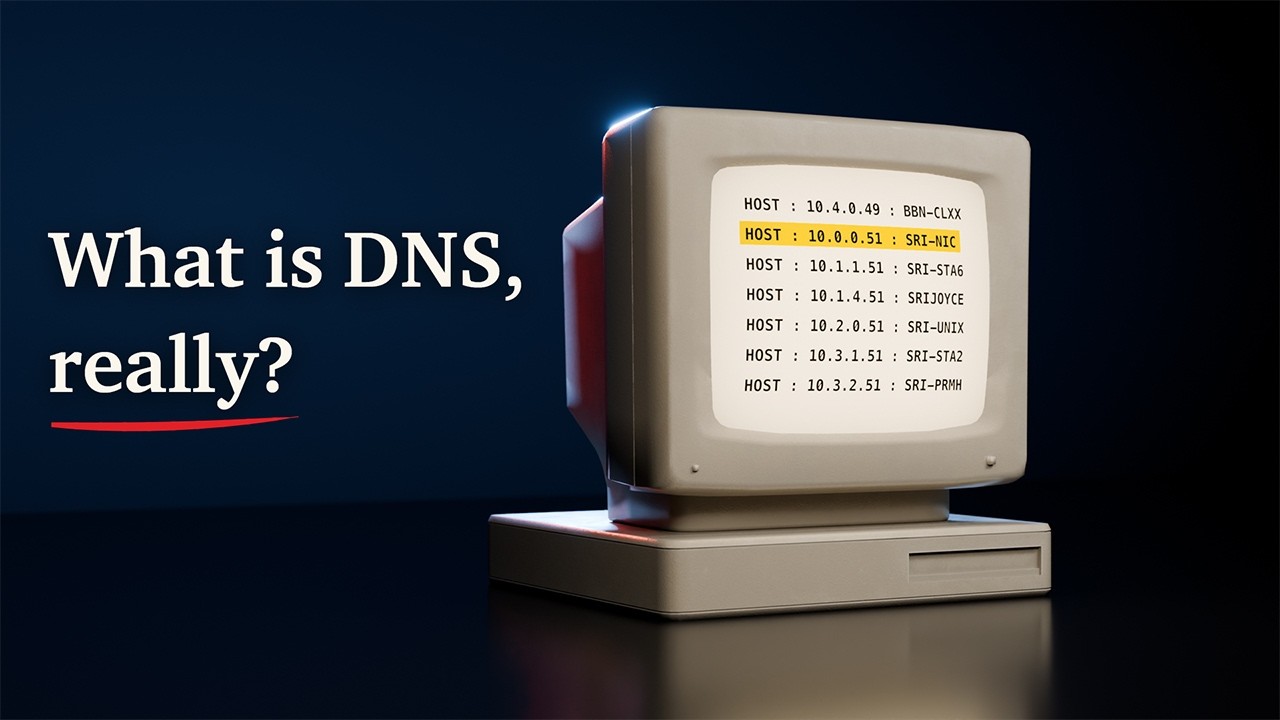
The Untold Story of DNS
Source: YouTube · CodeSource · published Oct 28, 2026 · 18:45
The DNS evolved from one manually maintained file into a global, distributed system, but a caching flaw warned of in 1983 has repeatedly let attackers hijack domains, forcing emergency fixes and DNSSEC 3:04.
Key Takeaways:
• Centralized origins: In the 1970s, the internet's address book was a single file, hosts.txt, kept by Elizabeth Feinler's team at Stanford—every new machine had to be registered through them 1:02.
• DNS is born: In 1983, Paul Mockapetris replaced the file with a distributed system, adding caching for speed while warning it could be "a potential source of incorrect results" 3:04.
• First exploit: In 1997, Eugene Kashpureff poisoned caches to hijack Network Solutions' domain as a protest, proving unverified cached data could be weaponized 7:15.
• Root server shift: In 1998, John Postel emailed root operators to redirect the root zone to his institute without government clearance—most switched, before being talked back 11:08.
• Kaminsky flaw: In 2008, Dan Kaminsky showed DNS caching let attackers hijack any domain in ~10 seconds, triggering a secret, coordinated patch by rival companies 13:45.
DNS's history shows the tension between efficiency and trust—its security still depends on ongoing vigilance and community governance.
Sources:
Generate CPE Credits
Generate a professional CPE document from this video's transcript.
Estimated credit: 0.5 CPE hours
Estimate uses the video runtime (1 hour ≈ 1 CPE, rounded to the nearest 0.5, minimum 0.5, maximum 2.0). The final amount can be lower after review, never higher.
Topic: Cybersecurity. Commonly maps to: Security and Risk Management, Security Operations. Exact CISSP domains are assigned during generation.
Free account. One generation at a time, with a daily limit.
CPEBuddy is independent and not affiliated with or endorsed by ISC2, ISACA, or any certification body. Exports are formatted for common CPE submissions; acceptance is at your certification body's discretion.
Transcript Preview
First 800 characters of the transcript
So like Paul, uh, we got a problem. >> In 2008, a researcher works out he can hijack any name on the internet in about 10 seconds. Your banks, anyone's. The hole is in DNS, the system that turns names into numbers. And its designer warned about this kind of hole in one sentence in 1983. He phones Paul Vixie, who looks after the software behind the internet's name servers. 10 years earlier, Vixie took another call from John Postell, the man who handed out the internet's names. Postell sent one email, and most of the internet's master servers followed him out from under the US government. Afterwards, everyone called it a test. The email doesn't contain the word. How does one woman's address book end up as the one thing on the internet nobody is allowed to own? Both calls lead back to one tex…