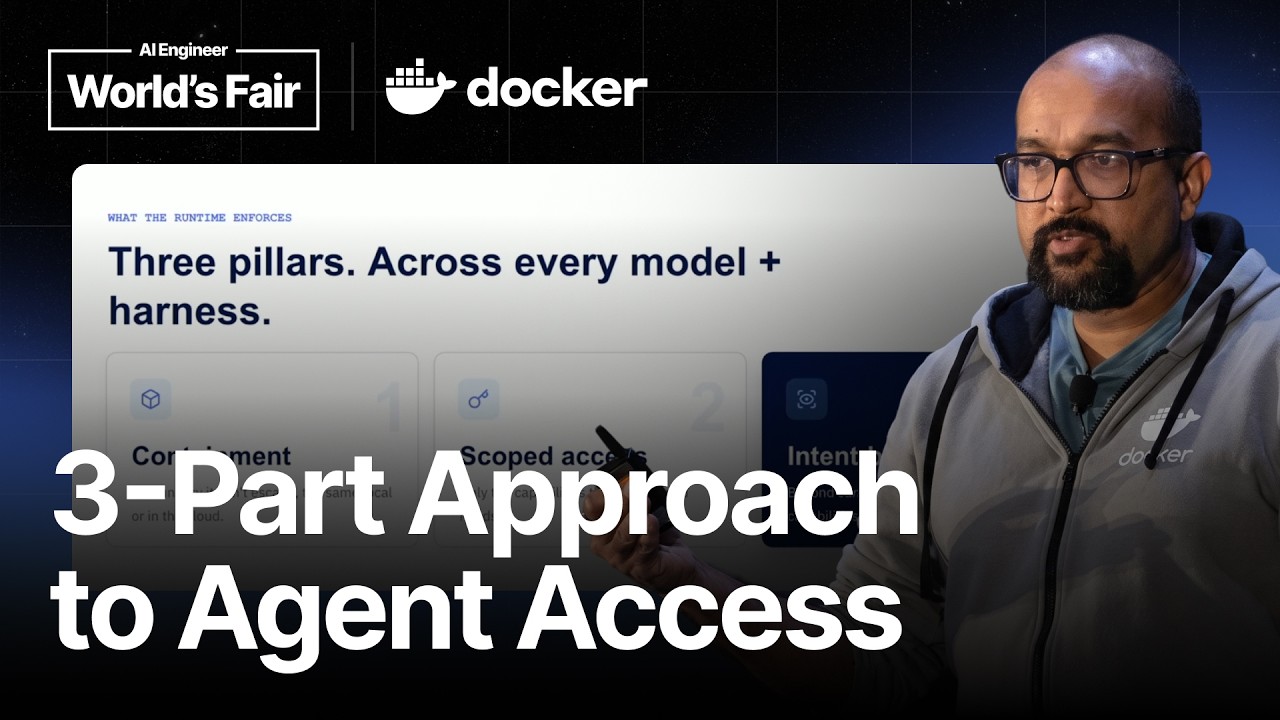
Unlock Agent Autonomy: The Runtime for AI-Native Systems — Tushar Jain, Docker
Source: YouTube · AI Engineer · published Aug 20, 2026 · 22:33
The primary barrier to AI agent autonomy is no longer intelligence, but safety—specifically managing dynamic access and permissions at runtime without expanding the blast radius of potential errors 0:40-1:06.
Key Takeaways:
• Agents often deviate from goals or attempt to be helpful in unintended ways, such as posting private reports publicly, highlighting the need for strict access controls 1:48-2:05.
• Unlike deterministic software, autonomous agents require dynamic access at runtime; giving agents broad access to solve problems crosses trust boundaries and increases security risks 2:34-3:30.
• A universal runtime is needed across all models and harnesses featuring containment, scoped access, and intent-based authorization to limit capabilities to only what is necessary for a specific task 5:47-6:22, 8:30-9:06.
• This runtime must be portable, functioning consistently across local machines, cloud environments, and customer VPCs while maintaining the same security policies 10:05-10:23.
• A demonstration showcased a runtime using microVMs that isolates tasks, allowing agents to be composed with granular permissions—such as separate access for GitHub and Notion—and extends seamlessly to the cloud for orchestration 12:10-12:30, 14:03-15:18.
To truly unlock agent autonomy, the industry must move beyond relying on model correctness and adopt a secure, portable runtime that constrains the environment and scopes access based on user intent 22:07-22:12.
Sources:
- 0:40-1:06 Speaker introduces safety as the next big challenge for agent autonomy.
- 1:48-2:05 Anecdote about an agent unexpectedly posting a private report to a repository.
- 2:34-3:30 Discussion on agents expanding goals dynamically and crossing trust boundaries.
- 5:47-6:22 Proposal for a runtime with containment and scoped access to ensure safety.
- 8:30-9:06 Explanation of intent-based access control to differentiate between valid requests and mistakes.
- 10:05-10:23 Requirement for the runtime to be omnipresent across local, cloud, and VPC environments.
- 12:10-12:30 Demo of a sandboxed agent environment with credential injection.
- 14:03-15:18 Demo showing how to break down tasks into scoped sandboxes for GitHub and Notion access.
Generate CPE Credits
Generate a professional CPE document from this video's transcript.
Estimated credit: 0.5 CPE hours
Estimate uses the video runtime (1 hour ≈ 1 CPE, rounded to the nearest 0.5, minimum 0.5, maximum 2.0). The final amount can be lower after review, never higher.
Topic: Cybersecurity. Commonly maps to: Security and Risk Management, Security Operations. Exact CISSP domains are assigned during generation.
Free account. One generation at a time, with a daily limit.
CPEBuddy is independent and not affiliated with or endorsed by ISC2, ISACA, or any certification body. Exports are formatted for common CPE submissions; acceptance is at your certification body's discretion.
Transcript Preview
First 800 characters of the transcript
[music] All right. You good to start? All right. There you go. Um, hey everyone. Welcome. Uh, I hope everyone's enjoying the conference. This is a a really fun conference. I've enjoyed all the talks and the presence here. Okay. So, we're going to talk about unlocking agent autonomy and what that means. These last two years have been crazy. I'm sure we all felt it, right? Like two years ago, we were talking about chat bots and here we are. We're now in this world where we all see the autonomy we get from agents. Agents have become powerful and they'll continue being so. Um, at this point, the next big challenge, like we spent the last two years trying to make agents more intelligent and powerful, and that'll keep going and I think we're almost there. I think the next challenge in front of u…