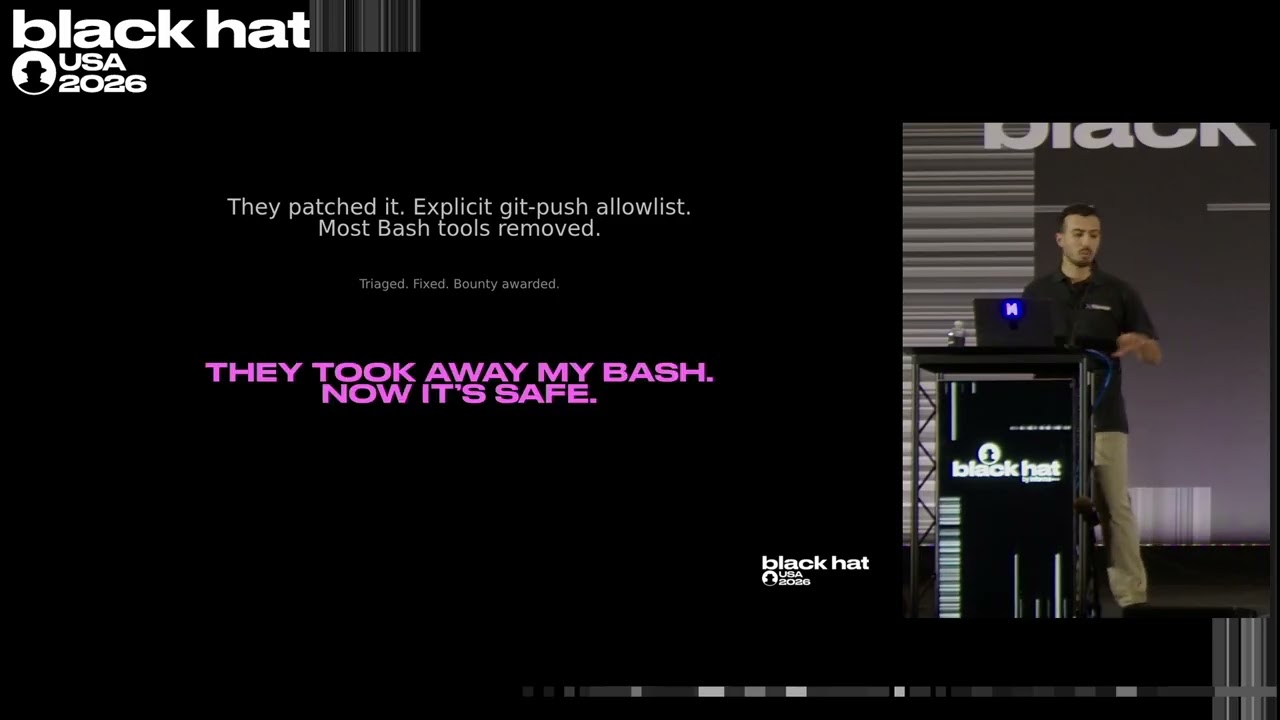
Black Hat USA 2026 | Trusted Enough to Run: Breaking AI Agents in Official Workflows
Source: YouTube · Black Hat · published Nov 22, 2026 · 35:11
AI Agent Security: How the Biggest AI Companies Got Autonomy Wrong
BLUF: Trusting AI agents to run autonomously in official workflows poses serious security risks—even at Anthropic, Google, and OpenAI—because prompt injection is an inherent part of the agent interface, and every harness ships with hidden trust assumptions that become vulnerabilities when deployed in CI/CD 0:21-0:32.
Key Takeaways:
• AI agents have an attack surface by design: untrusted text (issues, PRs, Slack, tickets) flows into the model while real actions (shell commands, file access, API calls) flow out—and prompt injection cannot be fully prevented since untrusted text is the delivery mechanism 1:17-1:49.
• An agent is a model plus a harness (tools, permissions, sandbox), and since the harness is code, it contains vulnerabilities and dozens of invisible trust decisions that deployers inherit 2:18-3:13.
• Anthropic's Claude Code Action tag-mode was exploited via a git push --receive-pack flag that executes arbitrary code locally, giving full RCE on the CI runner through a prompt injection in a GitHub issue 8:41-10:37.
• After patches, the researcher found an auto-approved arbitrary file read via tac (reverse cat, missing from path checks) and exfiltrated secrets through Hugging Face download counters—the "counter attack" 13:39-14:30, 20:00-21:08.
• Google's Gemini CLI YOLO mode stripped secrets from the child process, but reading /proc/<parent-pid>/environ from the same UID recovered all secrets; its tool allowlist was only enforced at registration time, not runtime 22:29-24:26.
• OpenAI's Codex two-pass issue triage shared one workspace: the first pass wrote attacker-controlled instructions to AGENTS.md, which the second, more privileged pass loaded—exfiltrating the GitHub token 30:47-31:35.
The consistent pattern: decide in one place, consume in another with more power—that's the bug. To audit your own agents, enumerate what's labeled "safe," find who consumes those labels with what authority, and read the defaults baked into binaries, not just the documentation 33:48-34:54.
Sources:
- 0:21-0:32 Thesis: autonomous AI agents in official workflows are a serious security risk
- 1:17-1:49 Prompt injection as a by-design attack surface
- 2:18-3:13 Agent = model + harness; harnesses carry hidden trust assumptions
- 8:41-10:37 Claude Code RCE via git push receive-pack and prompt injection demo
- 13:39-14:30 Arbitrary file read via tac bypassing path checks
- 20:00-21:08 Hugging Face download-counter secret exfiltration
- 22:29-24:26 Gemini CLI environment sanitization failure via /proc parent environ
Generate CPE Credits
Generate a professional CPE document from this video's transcript.
Estimated credit: 0.5 CPE hours
Estimate uses the video runtime (1 hour ≈ 1 CPE, rounded to the nearest 0.5, minimum 0.5, maximum 2.0). The final amount can be lower after review, never higher.
Topic: Cybersecurity. Commonly maps to: Security and Risk Management, Security Operations. Exact CISSP domains are assigned during generation.
Free account. One generation at a time, with a daily limit.
CPEBuddy is independent and not affiliated with or endorsed by ISC2, ISACA, or any certification body. Exports are formatted for common CPE submissions; acceptance is at your certification body's discretion.
Transcript Preview
First 800 characters of the transcript
Good afternoon everyone. First of all, thank you for being here today. It's a great to see many colleagues and friends here in the audience and I'm really glad to have the opportunity to share this session with you today. Today I will show how trusting AI agents to run autonomously in official workflows it's serious security risk and how even the biggest AI companies got it wrong. Let's start. Who am I? So I'm Alad Meged, founding engineering security researcher at Novi Security where I apply offensive methodology into the agents we build. We build AI agents that do penetration testing. And naturally, I founded myself ending up with pentesting the AI agents themselves. Look around. AI agents are everywhere. They're running your CI/CD, answering your Slack, triaging your tickets, and watchi…