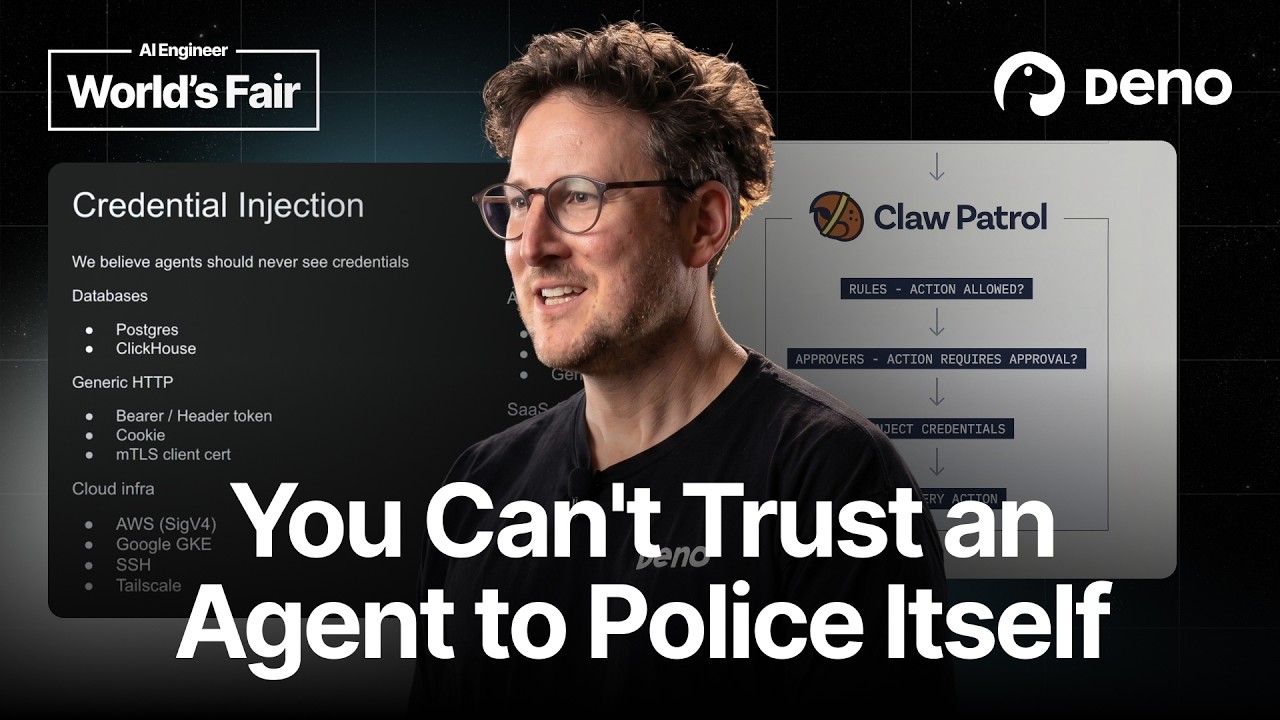
Security Firewall for Agents — Ryan Dahl, Deno
Source: YouTube · AI Engineer · published Aug 17, 2026 · 19:07
Dino CEO Ryan Dahl introduces Claw Patrol, an open-source proxy that enforces security boundaries on AI agents by inspecting and controlling network traffic at the byte level, rather than relying on the agents' internal alignment. 0:01
Key Takeaways:
• Agents are inherently untrusted; even well-aligned models can be manipulated via prompt injection or tunneling, necessitating external security controls. 2:47
• Existing solutions like LLM gateways or HTTP proxies are insufficient because they often fail to handle non-HTTP protocols (e.g., PostgreSQL) or complex credential injections. 7:40
• Claw Patrol acts as a proxy that intercepts all outbound bytes from agents, injecting credentials and applying granular rules via HCL configuration to block destructive actions. 10:00
• The system provides a dashboard for monitoring agent activity and supports approval workflows, allowing human or LLM judges to authorize sensitive requests. 13:14
• Security must be enforced at the network boundary; alignment is helpful but insufficient for real-world production safety. 16:32
Closing Statement:
By treating agents as black boxes and securing their external communications, organizations can safely deploy autonomous agents in production environments. This approach ensures that agents remain powerful while preventing catastrophic errors through rigorous network-level policy enforcement.
Sources:
- 0:01 Introduction to Dino Deploy and the use of AI agents for incident response.
- 2:47 Discussion on the dangers of relying solely on model alignment for security.
- 7:40 Limitations of current LLM gateways and HTTP proxies in securing agents.
- 10:00 Overview of Claw Patrol's architecture and HCL-based rule system.
- 13:14 Features of the Claw Patrol dashboard and approval mechanisms.
- 16:32 Thesis that security boundaries must be external to the agent software.
Generate CPE Credits
Generate a professional CPE document from this video's transcript.
Estimated credit: 0.5 CPE hours
Estimate uses the video runtime (1 hour ≈ 1 CPE, rounded to the nearest 0.5, minimum 0.5, maximum 2.0). The final amount can be lower after review, never higher.
Topic: Cybersecurity. Commonly maps to: Security and Risk Management, Security Operations. Exact CISSP domains are assigned during generation.
Free account. One generation at a time, with a daily limit.
CPEBuddy is independent and not affiliated with or endorsed by ISC2, ISACA, or any certification body. Exports are formatted for common CPE submissions; acceptance is at your certification body's discretion.
Transcript Preview
First 800 characters of the transcript
[music] How's it going? >> Um, my name is Ryan. Um, I'm going to I I'm I'm the CEO at Dino and uh yeah, you been developing software for for quite a while at this point. You might know one of my projects, Node.js. Um, I want to talk about um a service that we're running at Dino called Dino Deploy. This is a system for hosting websites and it has incidences. It's it it has downtime occasionally and uh we've got a pager duty that fires. I'm sure you're all very familiar with the very scary alarm sound that wakes you up in the middle of the night. Um, and recently we've been playing around with using agents to automatically service these incidences. Um, in particular, OpenClaw, but other other agents as well. Um, and we've found a pattern that is working pretty well for us that I want to shar…