Authentication Explained: Sessions, JWT & OAuth
Source: YouTube · Anton Putra · published Nov 18, 2026 · 30:31
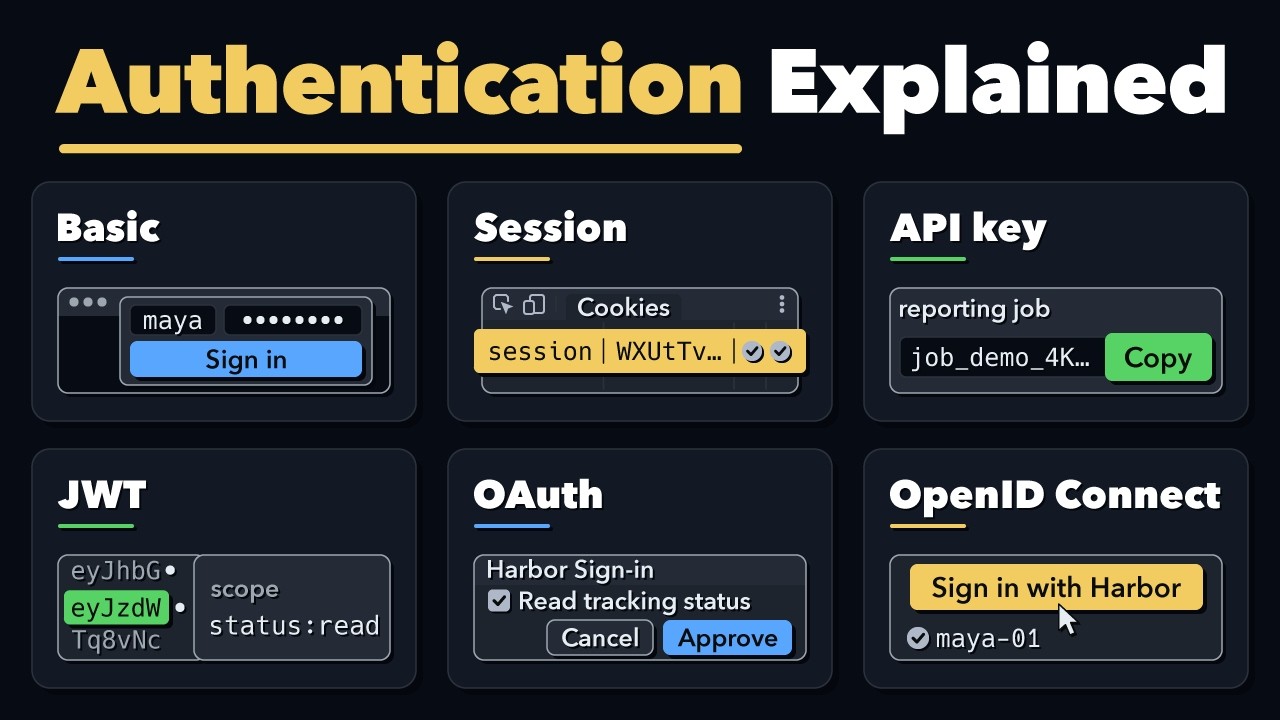
BLUF: This video demonstrates how to manage authentication and authorization in a complex system by using sessions for user identity, API keys for internal services, and OAuth 2.0 with OpenID Connect for secure third-party access 1:34.
Key Takeaways:
• Basic Authentication is insecure because it sends credentials in every request, and Base64 encoding is not encryption, requiring HTTPS to protect data in transit 2:15.
• Session-based authentication uses cookies to store a session ID, allowing the server to track logged-in users without repeating password checks, but requires protection against Cross-Site Request Forgery (CSRF) using SameSite cookies 5:21.
• API keys are ideal for server-to-server communication like reporting jobs, providing a secret credential that can be rotated or revoked without affecting user sessions 8:45.
• JWTs allow APIs to validate permissions locally without server lookups, but they cannot be revoked before expiration, making short-lived tokens essential for security 13:23.
• OAuth 2.0 enables third-party partners to access resources via an authorization code flow with PKCE, ensuring the partner never sees the user's password 19:04.
• OpenID Connect (OIDC) extends OAuth 2.0 to provide identity verification, allowing the dashboard to confirm who signed in via an ID token while using a separate access token for API calls 24:44.
Closing Statement: By combining these technologies, Harbor achieves a secure, scalable architecture where each component handles its specific role in identity and access management.
Sources:
- 1:34 Introduction to the five authentication methods covered.
- 2:15 Explanation of Basic Authentication and Base64 encoding.
- 5:21 How sessions and cookies work for user login.
- 8:45 Use of API keys for automated reporting jobs.
- 13:23 Structure and validation of JSON Web Tokens (JWT).
- 19:04 OAuth 2.0 authorization code flow for partners.
- 24:44 OpenID Connect for identity verification.
Generate CPE Credits
Generate a professional CPE document from this video's transcript.
Estimated credit: 0.5 CPE hours
Estimate uses the video runtime (1 hour ≈ 1 CPE, rounded to the nearest 0.5, minimum 0.5, maximum 2.0). The final amount can be lower after review, never higher.
Topic: Identity & Access Management. Commonly maps to: Identity and Access Management (IAM), Security Architecture and Engineering. Exact CISSP domains are assigned during generation.
Free account. One generation at a time, with a daily limit.
CPEBuddy is independent and not affiliated with or endorsed by ISC2, ISACA, or any certification body. Exports are formatted for common CPE submissions; acceptance is at your certification body's discretion.
Transcript Preview
First 800 characters of the transcript
Maya is a DevOps engineer at Harbor,
a delivery company. Her team just updated
the tracking service. It's the program that tells customers
where their packages are. Is it still up and running? To find out, she opens her dashboard. It shows a status for each service. If all is well, the status says Healthy. But the dashboard does not have
the status yet. Her browser has to ask for it. It's on the server:
the computer running the application. And the server says no.
The status is private, and the browser did not say who is asking. Harbor's dashboard gets
its data using an API. An API lets a program ask another program
for information, or ask it to take an action. Let's look at the browser's request. It's a message to the server,
asking for information. GET is for reading data. The part after…